
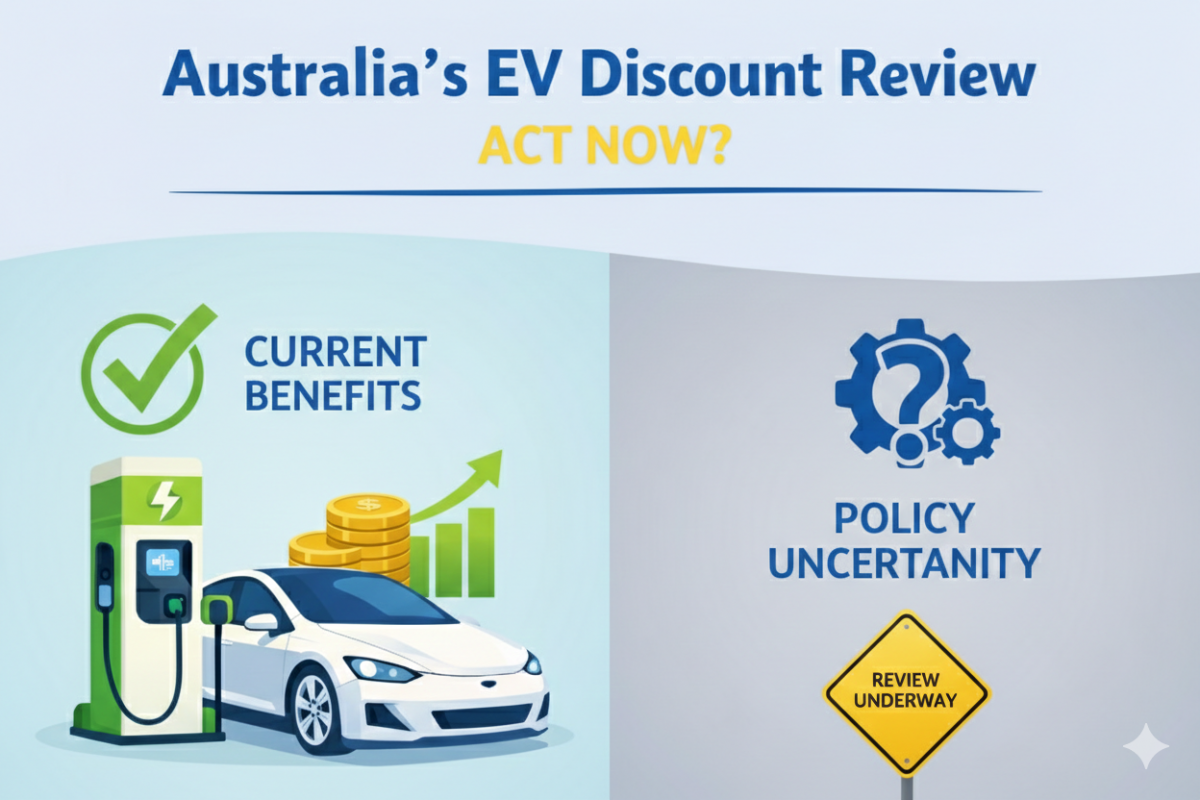
Electric vehicles (EVs) have officially shifted from a “niche” choice to a mainstream reality. By late 2025, EVs have captured over 8% of all new car sales in Australia—a massive jump fuelled largely by the Federal Government’s Electric Car Discount introduced in 2022. For many savvy business owners and employees, this policy hasn’t just been a win for the environment; it’s been a massive win for the bottom line.
However, the landscape is shifting. The government has officially launched a statutory review of these incentives. While there’s no need to panic, it is a critical moment to assess your options. Here is a breakdown of what’s happening, why the rules are under the microscope, and how you should navigate the next 12 months.
The Perks: Why Everyone is Going Electric
Currently, the “discount” isn’t a simple cash rebate. Instead, it operates through a series of powerful tax concessions that drastically lower the total cost of ownership:
- The FBT Jackpot: If a business provides an eligible EV to an employee for private use, it is exempt from Fringe Benefits Tax (FBT). Given that FBT is effectively charged at up to 47%, this exemption can slash the annual after-tax cost of a vehicle by thousands of dollars. It’s easily the most significant saving available in salary packaging today.
- The LCT “Green” Ceiling: For the 2025–26 financial year, the Luxury Car Tax (LCT) threshold for fuel-efficient vehicles is $91,387, significantly higher than the $76,950 limit for standard cars. This allows you to purchase a premium EV without triggering a 33% tax on the price difference.
- Import Duty Savings: Many eligible EVs are also exempt from the 5% customs duty, keeping the upfront acquisition price competitive with traditional engines.
Why Is the Government Reviewing the Rules?
In short: the policy was too successful. The uptake of EVs has far exceeded initial forecasts, meaning the cost to the federal budget has grown significantly.
The review is currently digging into whether the market is now strong enough to survive without subsidies, and if eligibility should be restricted to cheaper models. While public consultation is underway, the final report isn’t due until mid-2027. Any changes are likely to be “prospective,” meaning they would apply to future purchases, not the cars already on the road.
Strategy: Your Practical Move
While “review” can sound like a warning, the current rules are still legislated and very much in effect. If you are looking to update your fleet or personal vehicle, here is how to play it:
- Lock in “Grandfathering”: Historically, when tax rules change, existing contracts are “grandfathered.” By entering an arrangement now, you likely lock in the current benefits for the life of the lease, even if the laws change later (although we can’t guarantee this).
- The PHEV Deadline has Passed: Remember that as of 1 April, 2025, plug-in hybrids (PHEVs) are no longer eligible for new FBT-exempt arrangements. To get the big tax wins now, you need to go fully battery-electric or hydrogen.
- Mind the Price Limit: To qualify for the FBT exemption, the car must be below the LCT threshold at the time of purchase. Be careful with expensive optional extras—if they push you over that $91,387 mark, your FBT-free status could vanish instantly.
- Infrastructure Matters: Don’t assume your home charger is part of the deal. The tax treatment of charging infrastructure is distinct from the vehicle, so always check if it qualifies before you sign the paperwork.
The Bottom Line: The Electric Car Discount remains one of the most effective tax-saving tools in Australia. While the 2027 review introduces some long-term uncertainty, the savings today are real. If the numbers stack up for your business, there is little reason to wait.
Pitt Martin Group is a firm of Chartered Accountants, providing services including taxation, accounting, business consulting, self-managed superannuation funds, auditing and mortgage & finance. We spend hundreds of hours each year on training and researching new tax laws to ensure our clients can maximize legitimate tax benefit. Our contact information are phone +61292213345 or email info@pittmartingroup.com.au. Pitt Martin Group is located in the convenient transportation hub of Sydney’s central business district. Our honours include the 2018 CPA NSW President’s Award for Excellence, the 2020 Australian Small Business Champion Award Finalist, the 2021 Australia’s well-known media ‘Accountants Daily’ the Accounting Firm of the Year Award Finalist and the 2022 Start-up Firm of the Year Award Finalist, and the 2023 Hong Kong-Australia Business Association Business Award Finalist.
Pitt Martin Group qualifications include over fifteen years of professional experience in accounting industry, membership certification of the Chartered Accountants Australia and New Zealand (CA ANZ), membership certification of the Australian Society of Certified Practising Accountants (CPA), Registered Australia Tax Agents, certified External Examiner of the Law Societies of New South Wales, Victoria, and Western Australia Law Trust Accounts, membership certification of the Finance Brokers Association of Australia Limited (FBAA), Registered Agents of the Australian Securities and Investments Commission (ASIC), certified Advisor of accounting software such as XERO, QUICKBOOKS, MYOB, etc.
This content is for reference only and does not constitute advice on any individual or group’s specific situation. Any individual or group should take action only after consulting with professionals. Due to the timeliness of tax laws, we have endeavoured to provide timely and accurate information at the time of publication, but cannot guarantee that the content stated will remain applicable in the future. Please indicate the source when forwarding this content.
By Yvonne Shao @ Pitt Martin Tax
