
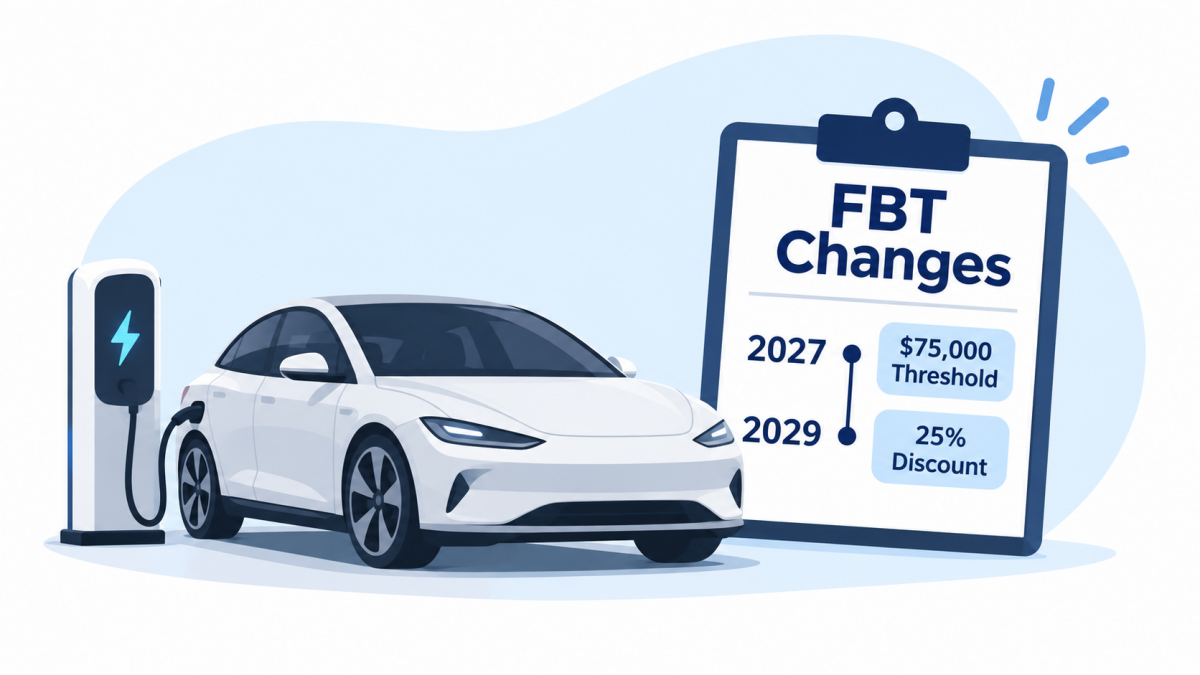
The Australian Government is proposing changes to the Fringe Benefits Tax (FBT) exemption for eligible electric vehicles (EVs), with the full exemption gradually being replaced by a 25% FBT discount. Under the proposed changes, the timing of a vehicle arrangement and its value will determine how much of the existing tax concession remains available.
The changes are expected to take effect in stages from 1 April 2027 and 1 April 2029. Although the proposed legislation is not yet law, businesses and employees considering an electric vehicle purchase, company car arrangement or novated lease should understand how the changes could affect their tax position and overall costs.
What Are the Proposed Electric Vehicle FBT Changes?
Currently, eligible battery electric vehicles and hydrogen fuel-cell vehicles can qualify for a full FBT exemption when provided by an employer for an employee’s private use, provided the relevant eligibility requirements are satisfied.
Plug-in hybrid electric vehicles (PHEVs) generally ceased qualifying for the exemption for new arrangements from 1 April 2025, although certain existing arrangements are protected under transitional rules.
Under the proposed changes, the full FBT exemption for eligible EVs will be gradually reduced as follows:
- Until 31 March 2027: The existing full FBT exemption continues for eligible EVs, regardless of their value, provided all eligibility requirements are met.
- From 1 April 2027 to 31 March 2029: Eligible EVs valued at $75,000 or less can retain the full FBT exemption if the commitment to provide the vehicle is made before 1 April 2029. Eligible vehicles valued above $75,000, but within the applicable fuel-efficient luxury car tax (LCT) threshold, will receive a 25% FBT discount.
- From 1 April 2029: New commitments involving eligible EVs within the relevant LCT threshold will only qualify for a 25% FBT discount, rather than the full exemption, regardless of whether the vehicle is valued above or below $75,000.
Existing arrangements are generally protected, subject to transitional rules. However, certain changes to an existing arrangement may be treated as a new commitment, potentially affecting its eligibility for the FBT concession.
Why Do the EV Purchase Date and $75,000 Threshold Matter?
The proposed changes mean that both the vehicle’s value and the timing of the arrangement could significantly affect the FBT benefits available to employers and employees.
For example:
- An eligible EV valued at $70,000 could potentially retain the full FBT exemption if a qualifying commitment is made before 1 April 2029.
- An eligible EV valued at $85,000 would generally only qualify for a 25% FBT discount if the commitment is made on or after 1 April 2027.
- From 1 April 2029, new qualifying arrangements will only receive the 25% FBT discount, even for eligible EVs valued below $75,000.
It is important to understand that the $75,000 threshold is based on the vehicle’s relevant value for FBT purposes, not necessarily its advertised drive-away price. Buyers should confirm the applicable vehicle value before entering into an arrangement.
The date the vehicle is ordered or delivered may also not be the determining factor. The proposed rules focus on when a financially binding commitment to provide the vehicle is made.
Businesses and employees should also be aware that certain changes to existing arrangements, including refinancing or changes in employment circumstances, may affect the availability of the concession.
How Can Businesses and Employees Prepare for the EV FBT Changes?
If you are considering purchasing an electric vehicle through your business or entering into a salary packaging arrangement, there are several practical steps worth taking:
1. Review your EV purchase and leasing options early
If you are planning to purchase an EV or enter into a novated lease, consider how the proposed changes could affect the timing and overall cost of the arrangement.
2. Check the vehicle’s value and eligibility
Confirm whether the vehicle’s relevant FBT value is at or below $75,000 and whether it falls within the applicable LCT threshold. The vehicle must also satisfy the other eligibility requirements for the EV FBT concession.
3. Confirm when your commitment becomes binding
Speak with your employer or salary packaging provider to establish when the arrangement becomes a financially binding commitment. This date may be more important than the vehicle’s delivery date.
4. Compare the total ownership and running costs
Consider the vehicle purchase price, lease repayments, running costs and potential tax savings. The FBT concession is only one part of the overall financial decision.
5. Understand other tax and reporting implications
Even where an EV qualifies for the FBT exemption, an employee may still have a reportable fringe benefits amount (RFBA). This amount is not included in taxable income but may affect certain income-tested obligations and entitlements, including Medicare levy surcharge calculations and government benefits.
Plan Ahead Before Purchasing an Electric Vehicle
The proposed EV FBT changes are intended to maintain tax support for electric vehicles while gradually reducing the full FBT exemption.
For businesses and employees, the key considerations are the vehicle’s value, its eligibility for the concession and, importantly, when the commitment to provide the vehicle is made.
If you are considering purchasing an electric vehicle through your business or a novated lease, it is worth reviewing your options before committing. Understanding the proposed FBT changes now can help you assess the potential after-tax cost and make an informed decision that suits your financial and business circumstances.
Need Help?
Contact us if you would like to discuss how the proposed electric vehicle FBT changes may affect your business or salary packaging arrangements.
Pitt Martin Group is a firm of Chartered Accountants, providing services including taxation, accounting, business consulting, self-managed superannuation funds, auditing and mortgage & finance. We spend hundreds of hours each year on training and researching new tax laws to ensure our clients can maximize legitimate tax benefit. Our contact information are phone +61292213345 or email info@pittmartingroup.com.au. Pitt Martin Group, Sydney tax accountants, is located in the convenient transportation hub of Sydney’s central business district. Our honours include the 2018 CPA NSW President’s Award for Excellence, the 2020 Australian Small Business Champion Award Finalist, the 2021 Australia’s well-known media ‘Accountants Daily’ the Accounting Firm of the Year Award Finalist and the 2022 Start-up Firm of the Year Award Finalist, and the 2023 Hong Kong-Australia Business Association Business Award Finalist.
Pitt Martin Group qualifications include over fifteen years of professional experience in accounting industry, Registered Australia Tax Agents, membership certification of the Chartered Accountants Australia and New Zealand (CA ANZ), certified External Examiner of the Law Societies of New South Wales, Victoria, and Western Australia Law Trust Accounts, membership certification of the Finance Brokers Association of Australia Limited (FBAA), Registered Agents of the Australian Securities and Investments Commission (ASIC), certified Advisor of accounting software such as XERO, QUICKBOOKS, MYOB, etc.
This content is for reference only and does not constitute advice on any individual or group’s specific situation. Any individual or group should take action only after consulting with professionals. Due to the timeliness of tax laws, we have endeavoured to provide timely and accurate information at the time of publication, but cannot guarantee that the content stated will remain applicable in the future. Please indicate the source when forwarding this content.
By Yvonne Shao @ Pitt Martin Tax
