
Key Takeaways
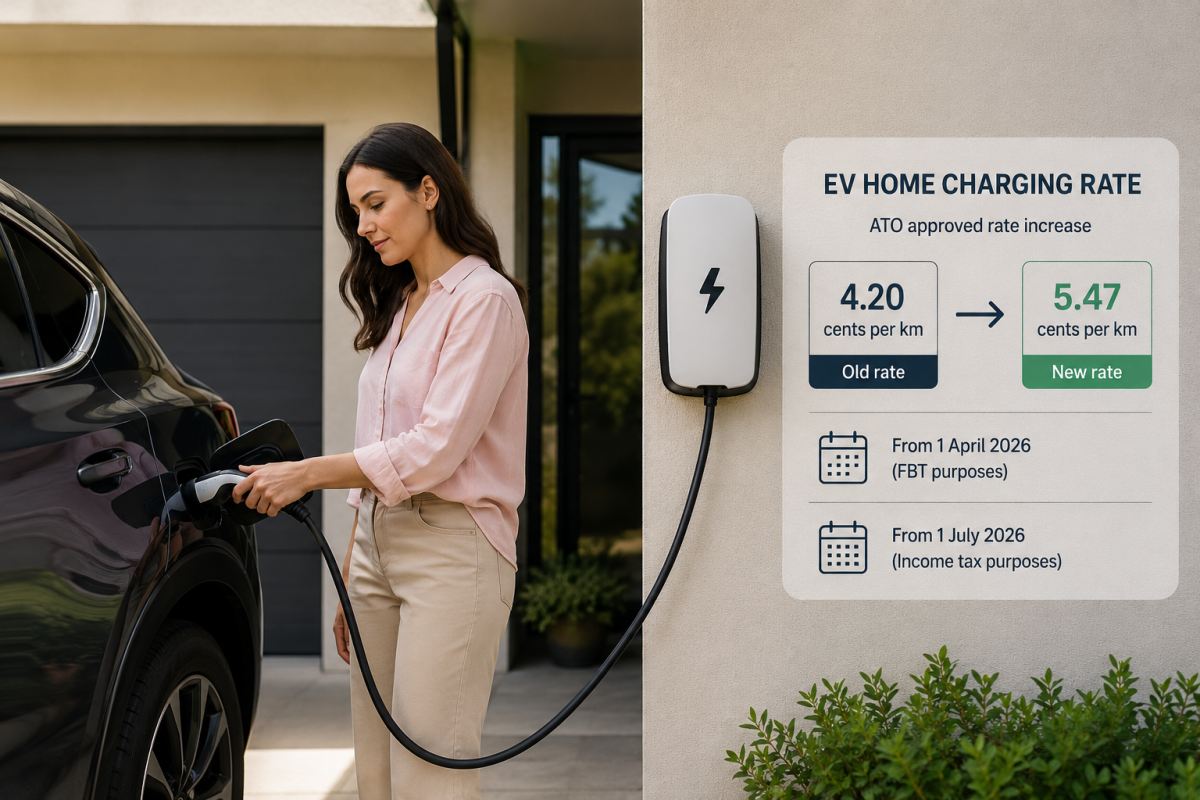
- The ATO’s standard EV home charging rate will increase from 4.20 cents to 5.47 cents per kilometre.
- The new rate applies from 1 April 2026 for Fringe Benefits Tax (FBT) purposes.
- The new rate applies from 1 July 2026 for income tax deductions.
- Employers providing EVs through novated leases, salary packaging arrangements or company vehicles may see changes to their FBT calculations.
- Individuals claiming work-related electric vehicle expenses using the logbook method may be entitled to larger deductions.
- Minimal record-keeping is required to use the ATO’s simplified method.
The Australian Taxation Office (ATO) has announced changes to the approved EV home charging rate, which may affect taxpayers and employers using electric vehicles (EVs) or plug-in hybrid electric vehicles (PHEVs) for work-related purposes where charging occurs at home.
For fringe benefits tax (FBT) purposes, the revised rate will apply from 1 April 2026, while income tax claims will adopt the change from 1 July 2026. Under the update, the approved home-charging electricity rate will increase from 4.20 cents per kilometre to 5.47 cents per kilometre.
Where household electricity bills do not separately identify EV charging usage, the ATO allows taxpayers to rely on this simplified cents-per-kilometre calculation method. This removes the need to track electricity consumption in kilowatt hours or install specialized charging measurement equipment. Instead, taxpayers can estimate charging costs by multiplying the approved rate by the distance travelled by the vehicle.
The revised amount reflects higher electricity prices and is intended to provide businesses and individuals with a more commercially realistic charging allowance.
Home Charging Electricity Rate Impact on Employers
Employers supplying EVs or PHEVs through salary packaging arrangements, novated leasing structures, or company-owned vehicles may see changes to their FBT calculations as a result of the increased EV home charging rate. In practice, the update may:
• Increase the taxable value of the benefit when the operating cost method is adopted.
• Result in larger employee recipient contributions, potentially reducing the employer’s FBT liability.
• Affect the calculation of reportable fringe benefits amounts.
Claiming Deductions for Electric Vehicle Charging Costs
Taxpayers using the logbook method to claim work-related vehicle expenses may apply the new rate to the business-use portion of kilometres travelled from the commencement of the 2026–27 income year. Earlier periods, including years dating back to 2022, must continue using the previous 4.20-cent rate.
Records Required for EV Charging Expense Claims
Only limited records are required to support these claims. Taxpayers should retain:
• Odometer readings taken at the beginning and end of the relevant income or FBT year where possible.
• A compliant logbook identifying business and private travel if using the operating cost or logbook method.
• At least one electricity bill demonstrating that home electricity expenses are incurred.
• For PHEVs, petrol receipts should also be retained. Fuel expenses must be calculated separately using the manufacturer’s hybrid fuel consumption figures, while the ATO home-charging rate applies solely to electric kilometres travelled.
Tip: Many newer EV models now report the proportion of charging completed at home compared with public charging stations. Using this information may improve calculation accuracy and potentially increase deductions.
Example of the Revised Home Charging Rate
If an employee owns an EV and travels 25,000 kilometres for employment purposes during the 2026–27 income year, the home-charging expense calculation would be:
Home-charging cost = 25,000 × 5.47c = $1,367.50 (previously $1,050).
Compared with the earlier rate, the additional $317.50 may assist in lowering the employee’s taxable income for the relevant year.
Preparing for the New Electric Vehicle Charging Rules
• The existing lower rate should continue to be used for the FBT year ending 31 March 2026 and for income tax deductions relating to the year ending 30 June 2026.
• The revised rate should only be applied for the current FBT year and for income years commencing from 1 July 2026.
The adoption of electric vehicles continues to grow, and the updated ATO rate is expected to deliver improved tax outcomes for many taxpayers while maintaining a straightforward compliance process. Whether you operate a vehicle fleet, offer salary packaging arrangements, or claim motor vehicle expenses personally, now is an ideal time to assess the potential benefits. Our team can help you evaluate the impact and ensure you maximise all available tax concessions and deductions.
Need Help?
By working with us as your professional tax accountant and mortgage broker, you can be confident that your loans are structured to protect your tax position, maximise deductions, and avoid costly mistakes, giving you greater peace of mind and more control over your financial future.
Pitt Martin Group is a firm of Chartered Accountants, providing services including taxation, accounting, business consulting, self-managed superannuation funds, auditing and mortgage & finance. We spend hundreds of hours each year on training and researching new tax laws to ensure our clients can maximize legitimate tax benefit. Our contact information are phone +61292213345 or email info@pittmartingroup.com.au. Pitt Martin Group is located in the convenient transportation hub of Sydney’s central business district. Our honours include the 2018 CPA NSW President’s Award for Excellence, the 2020 Australian Small Business Champion Award Finalist, the 2021 Australia’s well-known media ‘Accountants Daily’ the Accounting Firm of the Year Award Finalist and the 2022 Start-up Firm of the Year Award Finalist, and the 2023 Hong Kong-Australia Business Association Business Award Finalist.
Pitt Martin Group qualifications include over fifteen years of professional experience in accounting industry, membership certification of the Chartered Accountants Australia and New Zealand (CA ANZ), membership certification of the Australian Society of Certified Practising Accountants (CPA), Registered Australia Tax Agents, certified External Examiner of the Law Societies of New South Wales, Victoria, and Western Australia Law Trust Accounts, membership certification of the Finance Brokers Association of Australia Limited (FBAA), Registered Agents of the Australian Securities and Investments Commission (ASIC), certified Advisor of accounting software such as XERO, QUICKBOOKS, MYOB, etc.
This content is for reference only and does not constitute advice on any individual or group’s specific situation. Any individual or group should take action only after consulting with professionals. Due to the timeliness of tax laws, we have endeavoured to provide timely and accurate information at the time of publication, but cannot guarantee that the content stated will remain applicable in the future. Please indicate the source when forwarding this content.
