
If your business is planning to buy or lease a vehicle in the new financial year, the updated 2026–27 car thresholds from the Australian Taxation Office (ATO) are worth a look before you sign anything. They shape three things that matter to your bottom line: depreciation, GST recovery, and whether Luxury Car Tax (LCT) applies.
For vehicles first used or leased from 1 July 2026, the car limit, GST credit cap, and LCT thresholds have all increased with indexation. Understanding how they interact can help you time a purchase and avoid surprises at tax time.
The Car Limit: The Depreciation Cap
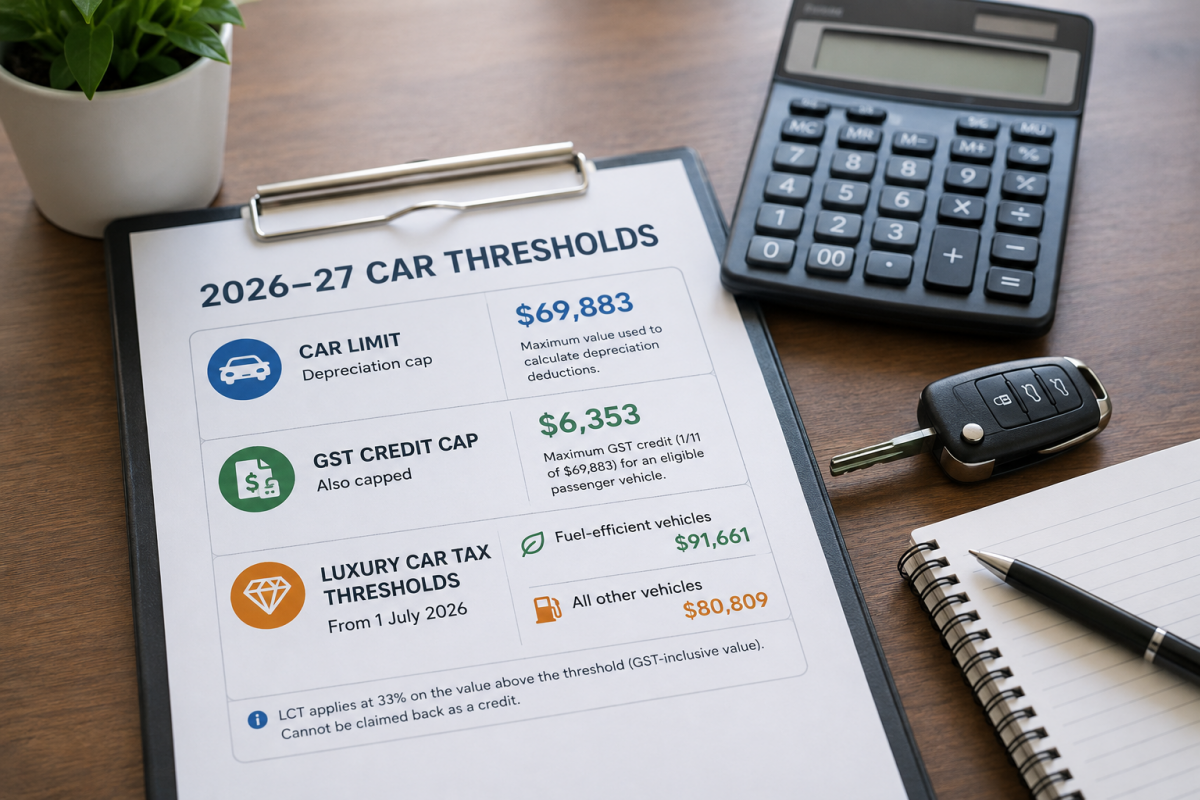
For 2026–27, the ATO car limit is $69,883, the maximum value used to calculate depreciation deductions for a passenger vehicle, regardless of actual purchase price. Buy above this and the excess generally cannot be depreciated. There may be good commercial reasons to buy something pricier, but beyond the car limit, extra spend typically produces no additional tax benefit.
A few points worth noting:
- Mixed use: If a vehicle is used for both business and private purposes, you can only claim the business-use portion. A valid logbook, kept for a continuous 12-week period with odometer readings, is essential evidence if the ATO reviews your claim.
- Depreciation method: Businesses may be eligible for simplified small business depreciation rules, allowing accelerated deductions. Confirm eligibility with your tax agent before purchase.
- Timing: The applicable car limit is set by the income year the car is first used or held ready for use, not the invoice date. This matters if delivery slips past 1 July.
GST Credits: Also Capped
Businesses registered for GST can generally claim GST credits on vehicles bought for business use, but this is also capped by reference to the car limit. Once the price exceeds the limit, the credit is capped at one-eleventh of the limit, not one-eleventh of the actual price.
For 2026–27, the maximum GST credit on an eligible passenger vehicle is $6,353 (one-eleventh of $69,883), regardless of actual cost, and this applies to fuel-efficient and non-fuel-efficient vehicles alike.
Some flow-on consequences:
- Selling later: GST is generally payable on the full sale price when the vehicle is sold, even though the credit claimed at purchase was capped. This asymmetry can catch owners off guard.
- BAS reporting: Only the car-limit amount (or its business-use proportion) is reported at label G10, with the capped credit at label 1B.
- Time limits: GST credits must generally be claimed within four years, so reconcile purchases promptly.
- Cash flow: The credit is often a meaningful short-term benefit, worth weighing against financing or leasing.
Luxury Car Tax Thresholds Rise From 1 July 2026
Luxury car tax rate and thresholds (LCT) is a separate consideration, with its own thresholds, also increased for 2026–27:
- $91,661 for fuel-efficient vehicles
- $80,809 for all other vehicles
Where the GST-inclusive value exceeds the relevant threshold, LCT generally applies at 33% on the value above it. Unlike GST, LCT cannot be claimed back as a credit, even for vehicles used entirely for business.
The gap between the two thresholds is increasingly relevant: more hybrid, plug-in hybrid and electric models now qualify for the higher threshold, reducing LCT versus an equivalent petrol or diesel model. This is worth weighing for fleets or client-facing vehicles. Check the current ATO definition before assuming a model qualifies, as the eligibility test has tightened in recent years.
Planning Ahead
Since these thresholds apply to any vehicle first used or leased from 1 July 2026, now is a good time to review planned purchases. Before committing, work through:
- Total after-tax cost of ownership: depreciation, GST credits, LCT, financing, insurance and running costs, not just the drive-away price.
- Buy versus lease: Outright purchase, chattel mortgage, novated leasing and operating leases each carry different depreciation, GST and cash flow implications, depending on turnover, cash position and vehicle use.
- Business-use percentage: the records needed to support it, including a logbook, odometer readings, and trip diary where relevant.
- Cash flow timing: whether to bring a purchase forward before 30 June or defer until after 1 July.
Key Takeaways
A business vehicle can be a significant investment. While tax considerations should not be the sole factor in your decision, they can play an important role in determining the overall cost of ownership.
Before making a purchase, it is worth speaking with your accountant to assess the potential tax implications based on your individual circumstances. Planning ahead can help you make the most of available tax concessions, avoid unexpected costs and ensure the purchase supports your broader business strategy.
For more information, refer to the ATO’s Small Business Newsroom: Car thresholds from 1 July | Australian Taxation Office, or contact our team to discuss how these changes may apply to your business.
Need Help?
By working with us as your professional tax accountant and mortgage broker, you can be confident that your loans are structured to protect your tax position, maximise deductions, and avoid costly mistakes, giving you greater peace of mind and more control over your financial future.
Pitt Martin Group is a firm of Chartered Accountants, providing services including taxation, accounting, business consulting, self-managed superannuation funds, auditing and mortgage & finance. We spend hundreds of hours each year on training and researching new tax laws to ensure our clients can maximize legitimate tax benefit. Our contact information are phone +61292213345 or email info@pittmartingroup.com.au. Pitt Martin Group is located in the convenient transportation hub of Sydney’s central business district. Our honours include the 2018 CPA NSW President’s Award for Excellence, the 2020 Australian Small Business Champion Award Finalist, the 2021 Australia’s well-known media ‘Accountants Daily’ the Accounting Firm of the Year Award Finalist and the 2022 Start-up Firm of the Year Award Finalist, and the 2023 Hong Kong-Australia Business Association Business Award Finalist.
Pitt Martin Group qualifications include over fifteen years of professional experience in accounting industry, Registered Australia Tax Agents, membership certification of the Chartered Accountants Australia and New Zealand (CA ANZ), certified External Examiner of the Law Societies of New South Wales, Victoria, and Western Australia Law Trust Accounts, membership certification of the Finance Brokers Association of Australia Limited (FBAA), Registered Agents of the Australian Securities and Investments Commission (ASIC), certified Advisor of accounting software such as XERO, QUICKBOOKS, MYOB, etc.
This content is for reference only and does not constitute advice on any individual or group’s specific situation. Any individual or group should take action only after consulting with professionals. Due to the timeliness of tax laws, we have endeavoured to provide timely and accurate information at the time of publication, but cannot guarantee that the content stated will remain applicable in the future. Please indicate the source when forwarding this content.
By Nora Pham @ Pitt Martin Tax
