
Skip to main content Skip to search

Archives for GST

Navigating the 2026–27 Car Thresholds

解读 2026–27 年度汽车税务门槛:澳大利亚企业必须了解的事项

如果您的企业计划在新财年购买或租赁车辆,那么在签署任何购车或租赁协议之前,值得先了解澳大利亚税务局(ATO)最新公布的 2026–27 年度汽车税务门槛(car thresholds)。这些门槛会直接影响三个与企业最终成本密切相关的重要事项:折旧、GST 抵免,以及是否适用豪华汽车税(Luxury Car Tax,LCT)。

对于从 2026 年 7 月 1 日起首次投入使用或租赁的车辆,汽车限额(car limit)、GST 抵免上限以及 LCT 门槛均因指数化调整而提高。了解这些规定之间的相互关系,可以帮助企业合理安排购车时间,并避免在报税时出现意外的税务成本。

Car Limit:折旧上限

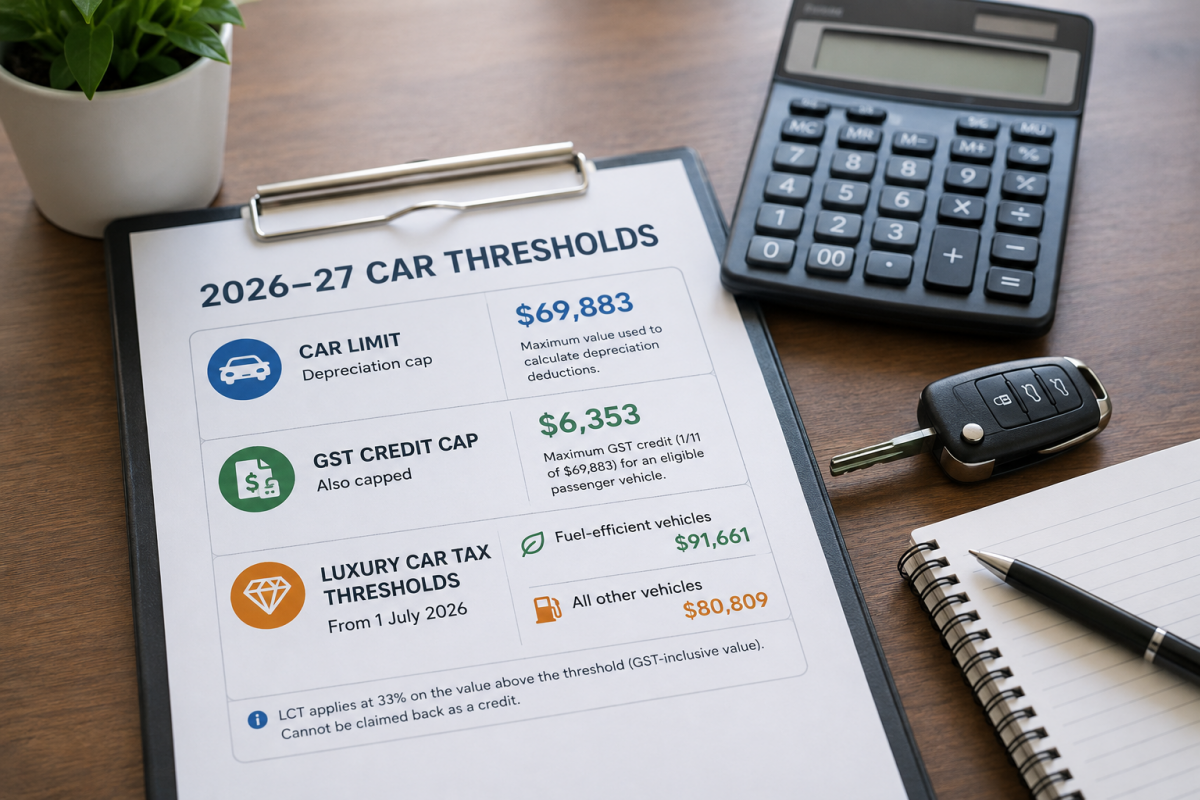
2026–27 年度的 ATO 汽车限额(car limit)为 $69,883。这是计算乘用车折旧扣除时所能采用的最高车辆价值,无论车辆的实际购买价格是多少。

如果车辆购买价格超过这一限额,超过部分通常不能用于计算折旧。购买价格更高的车辆可能具有商业上的合理性,但从税务角度来看,超过 car limit 的额外支出通常不会带来额外的折旧税务优惠。

以下几点值得注意:

  • 混合用途:如果车辆同时用于商业和私人用途,通常只能申报与商业用途相对应的部分。如果 ATO 对您的申报进行审查,完整、有效的 logbook(行车记录簿)是支持商业使用比例的重要证据。Logbook 通常需要连续记录 12 周,并记录车辆的里程表读数。
  • 折旧方法:符合条件的小型企业可能可以采用简化小企业折旧规则(simplified small business depreciation rules),从而获得加速折旧扣除。建议在购买车辆之前向您的税务代理确认企业是否符合资格。
  • 时间点:适用的 car limit 取决于车辆在哪一个收入年度首次投入使用或已准备好投入使用(first used or held ready for use),而不是发票日期。如果车辆交付时间跨过 7 月 1 日,这一点尤其重要。

GST 抵免:同样存在上限

已注册 GST 的企业通常可以就用于商业用途的车辆购买申报 GST(进项 GST 抵免),但这一抵免同样受到 car limit 的限制。

当车辆价格超过 car limit 后,GST 抵免最高只能按照 car limit 的 1/11 计算,而不是按照车辆实际购买价格的 1/11 计算。

对于 2026–27 年度,符合条件的乘用车最高 GST 抵免为:

$6,353

即:

$69,883 ÷ 11 = $6,353

无论车辆实际购买价格是多少,该上限原则上同样适用于节能型车辆和非节能型车辆。

此外,还需要考虑以下影响:

  • 以后出售车辆:当车辆出售时,即使企业在购买车辆时只能申报受限的 GST 抵免,出售时通常仍需要按照车辆的全部销售价格计算 GST。这种不对称的税务处理可能会让部分企业主感到意外。
  • BAS 申报:通常只有 car limit 金额(或相应的商业使用比例)在 BAS 的 G10 进行申报,而受限的 GST 抵免则在 1B 申报。
  • 时间限制:GST 抵免通常必须在四年的期限内申报,因此应及时核对和处理车辆购买相关的 GST。
  • 现金流:GST 抵免通常可以带来一项较为明显的短期现金流利益,在比较融资购买和租赁方案时,也应将这一因素纳入考虑。

豪华汽车税(LCT)门槛自 2026 年 7 月 1 日起提高

豪华汽车税(Luxury Car Tax,LCT)是另一个需要单独考虑的税务因素,其门槛与 GST 和 car limit 不同,并且 2026–27 年度也进行了调整:

  • 节能型车辆(fuel-efficient vehicles):$91,661
  • 其他车辆:$80,809

如果车辆的含 GST 价值(GST-inclusive value)超过相应门槛,通常需要就超过门槛的部分按照 33% 的税率缴纳 LCT。

与 GST 不同,LCT 不能作为 GST input tax credit 申报抵免,即使车辆 100% 用于商业用途也是如此。

两个 LCT 门槛之间的差距越来越值得关注。现在越来越多的混合动力(hybrid)、插电式混合动力(plug-in hybrid)以及电动车(electric vehicle)车型可能符合较高的节能型车辆门槛,从而相较于价格相当的汽油或柴油车型,可以降低 LCT。

对于企业车队或需要经常接待客户、商务使用的车辆而言,这一点尤其值得纳入购车决策。

不过,在认定某一车型是否符合节能型车辆的资格之前,应查看 ATO 当前的定义和要求,因为近年来相关资格测试已经有所收紧。

提前做好规划

由于这些门槛适用于 2026 年 7 月 1 日起首次投入使用或租赁的车辆,因此现在正是重新审视企业购车计划的好时机。

在作出购买决定之前,可以从以下几个方面进行分析:

  • 税后总体持有成本:不要只比较车辆的提车价,还应综合考虑折旧、GST 抵免、LCT、融资成本、保险以及日常运营成本。
  • 购买还是租赁:直接购买、chattel mortgage(动产抵押贷款)、novated lease(薪资包装租赁)以及 operating lease(经营租赁)在折旧、GST 和现金流方面可能产生不同的税务结果,具体取决于企业营业额、现金状况以及车辆的实际用途。
  • 商业使用比例:应提前考虑需要哪些记录来支持商业使用比例,包括 logbook、里程表记录,以及在适当情况下的 行程记录。
  • 现金流时间安排:应考虑是在 6 月 30 日之前提前购买,还是推迟到 7 月 1 日之后购买,以及不同时间点可能产生的税务和现金流影响。

主要结论

企业购买车辆可能是一项相当大的投资。虽然税务因素不应该成为购车决策的唯一依据,但它们可能会对车辆的实际税后持有成本产生重要影响。

在购买车辆之前,建议与您的会计师或税务代理沟通,根据企业自身情况评估潜在的税务影响。

提前做好规划,可以帮助企业:

  • 更充分地利用可获得的税务优惠;
  • 避免意外的税务成本;
  • 合理安排现金流;
  • 确保车辆购买决定与企业整体经营和财务策略相匹配。

如需进一步了解相关规定,可以参考 ATO Small Business Newsroom 中关于 “Car thresholds from 1 July” 的最新信息,或者联系我们的团队,进一步讨论这些变化将如何适用于您的企业。

需要协助?

与我们这样的专业税务会计师和贷款经纪人合作,您可以放心,我们的团队可以提供针对性建议,确保贷款结构既能保护您的税务最大化扣除,同时避免错误的风险,从而让您更加安心,并更好地规划财务。

皮特马丁会计师事务所 Pitt Martin Group 是一家提供税务,会计,生意咨询,自管养老金,审计及贷款等综合性服务的经澳洲特许会计师协会认证的注册会计师事务所。我们每年会花上几百个小时去研究新的税法,以保证我们的客户可以最大化合理避税。我们的中文联系方式是 Robert Liu +61292213345 或邮件 info@pittmartingroup.com.au。皮特马丁会计师事务所Pitt Martin Group坐落在交通便利的悉尼市市中心,是一家拥有可以说中文合伙人的会计师事务所。我们的荣誉包括2018年CPA新州首席优秀奖, 2020年澳大利亚小生意年度冠军入围奖, 2021年澳洲知名媒体《每日会计师》年度最佳会计师事务所冠军入围奖,2022年最佳会计师事务所新人入围奖和2023香港澳大利亚商业协会最佳积极生意入围奖。

皮特马丁会计师事务所 Pitt Martin Group资质包括超过十五年的从业经验,澳大利亚税务注册代理,澳大利亚与新西兰特许会计师协会(CAANZ)会员,新州、维州和西澳律师协会信托账户 (Trust Account) 认证审计师,澳大利亚金融贷款经纪人协会(FBAA)执业认证会员,澳大利亚证券及投资委员会注册代理,XERO, QUICKBOOKS, MYOB等会计软件授权单位及认证顾问。

本文内容仅供参考,不构成对任何个人或团体的具体情况而形成建议。任何个人或团体应该在征求专业人士的意见后方可采取行动。由于税法的时效性,我们在发布时已致力于提供及时、准确的信息,但不能保证所称述的内容在今后任然可以适用。转发该文内容请注明出处。

By Robert Liu @ Pitt Martin Tax

Read more
Navigating the 2026–27 Car Thresholds

Navigating the 2026 – 2027 Car Thresholds: What Every Australian Business Needs to Know

If your business is planning to buy or lease a vehicle in the new financial year, the updated 2026–27 car thresholds from the Australian Taxation Office (ATO) are worth a look before you sign anything. They shape three things that matter to your bottom line: depreciation, GST recovery, and whether Luxury Car Tax (LCT) applies.

For vehicles first used or leased from 1 July 2026, the car limit, GST credit cap, and LCT thresholds have all increased with indexation. Understanding how they interact can help you time a purchase and avoid surprises at tax time.

The Car Limit: The Depreciation Cap

For 2026–27, the ATO car limit is $69,883, the maximum value used to calculate depreciation deductions for a passenger vehicle, regardless of actual purchase price. Buy above this and the excess generally cannot be depreciated. There may be good commercial reasons to buy something pricier, but beyond the car limit, extra spend typically produces no additional tax benefit.

A few points worth noting:

  • Mixed use: If a vehicle is used for both business and private purposes, you can only claim the business-use portion. A valid logbook, kept for a continuous 12-week period with odometer readings, is essential evidence if the ATO reviews your claim.
  • Depreciation method: Businesses may be eligible for simplified small business depreciation rules, allowing accelerated deductions. Confirm eligibility with your tax agent before purchase.
  • Timing: The applicable car limit is set by the income year the car is first used or held ready for use, not the invoice date. This matters if delivery slips past 1 July.

GST Credits: Also Capped

Businesses registered for GST can generally claim GST credits on vehicles bought for business use, but this is also capped by reference to the car limit. Once the price exceeds the limit, the credit is capped at one-eleventh of the limit, not one-eleventh of the actual price.

For 2026–27, the maximum GST credit on an eligible passenger vehicle is $6,353 (one-eleventh of $69,883), regardless of actual cost, and this applies to fuel-efficient and non-fuel-efficient vehicles alike.

Some flow-on consequences:

  • Selling later: GST is generally payable on the full sale price when the vehicle is sold, even though the credit claimed at purchase was capped. This asymmetry can catch owners off guard.
  • BAS reporting: Only the car-limit amount (or its business-use proportion) is reported at label G10, with the capped credit at label 1B.
  • Time limits: GST credits must generally be claimed within four years, so reconcile purchases promptly.
  • Cash flow: The credit is often a meaningful short-term benefit, worth weighing against financing or leasing.

Luxury Car Tax Thresholds Rise From 1 July 2026

Luxury car tax rate and thresholds (LCT) is a separate consideration, with its own thresholds, also increased for 2026–27:

  • $91,661 for fuel-efficient vehicles
  • $80,809 for all other vehicles

Where the GST-inclusive value exceeds the relevant threshold, LCT generally applies at 33% on the value above it. Unlike GST, LCT cannot be claimed back as a credit, even for vehicles used entirely for business.

The gap between the two thresholds is increasingly relevant: more hybrid, plug-in hybrid and electric models now qualify for the higher threshold, reducing LCT versus an equivalent petrol or diesel model. This is worth weighing for fleets or client-facing vehicles. Check the current ATO definition before assuming a model qualifies, as the eligibility test has tightened in recent years.

Planning Ahead

Since these thresholds apply to any vehicle first used or leased from 1 July 2026, now is a good time to review planned purchases. Before committing, work through:

  • Total after-tax cost of ownership: depreciation, GST credits, LCT, financing, insurance and running costs, not just the drive-away price.
  • Buy versus lease: Outright purchase, chattel mortgage, novated leasing and operating leases each carry different depreciation, GST and cash flow implications, depending on turnover, cash position and vehicle use.
  • Business-use percentage: the records needed to support it, including a logbook, odometer readings, and trip diary where relevant.
  • Cash flow timing: whether to bring a purchase forward before 30 June or defer until after 1 July.

Key Takeaways

A business vehicle can be a significant investment. While tax considerations should not be the sole factor in your decision, they can play an important role in determining the overall cost of ownership.

Before making a purchase, it is worth speaking with your accountant to assess the potential tax implications based on your individual circumstances. Planning ahead can help you make the most of available tax concessions, avoid unexpected costs and ensure the purchase supports your broader business strategy.

For more information, refer to the ATO’s Small Business Newsroom: Car thresholds from 1 July | Australian Taxation Office, or contact our team to discuss how these changes may apply to your business.

Need Help?

By working with us as your professional tax accountant and mortgage broker, you can be confident that your loans are structured to protect your tax position, maximise deductions, and avoid costly mistakes, giving you greater peace of mind and more control over your financial future.

Pitt Martin Group is a firm of Chartered Accountants, providing services including taxation, accounting, business consulting, self-managed superannuation funds, auditing and mortgage & finance. We spend hundreds of hours each year on training and researching new tax laws to ensure our clients can maximize legitimate tax benefit. Our contact information are phone +61292213345 or email info@pittmartingroup.com.au. Pitt Martin Group is located in the convenient transportation hub of Sydney’s central business district. Our honours include the 2018 CPA NSW President’s Award for Excellence, the 2020 Australian Small Business Champion Award Finalist, the 2021 Australia’s well-known media ‘Accountants Daily’ the Accounting Firm of the Year Award Finalist and the 2022 Start-up Firm of the Year Award Finalist, and the 2023 Hong Kong-Australia Business Association Business Award Finalist.

Pitt Martin Group qualifications include over fifteen years of professional experience in accounting industry, Registered Australia Tax Agents, membership certification of the Chartered Accountants Australia and New Zealand (CA ANZ), certified External Examiner of the Law Societies of New South Wales, Victoria, and Western Australia Law Trust Accounts, membership certification of the Finance Brokers Association of Australia Limited (FBAA), Registered Agents of the Australian Securities and Investments Commission (ASIC), certified Advisor of accounting software such as XERO, QUICKBOOKS, MYOB, etc.

This content is for reference only and does not constitute advice on any individual or group’s specific situation. Any individual or group should take action only after consulting with professionals. Due to the timeliness of tax laws, we have endeavoured to provide timely and accurate information at the time of publication, but cannot guarantee that the content stated will remain applicable in the future. Please indicate the source when forwarding this content.

By Nora Pham @ Pitt Martin Tax

Read more