
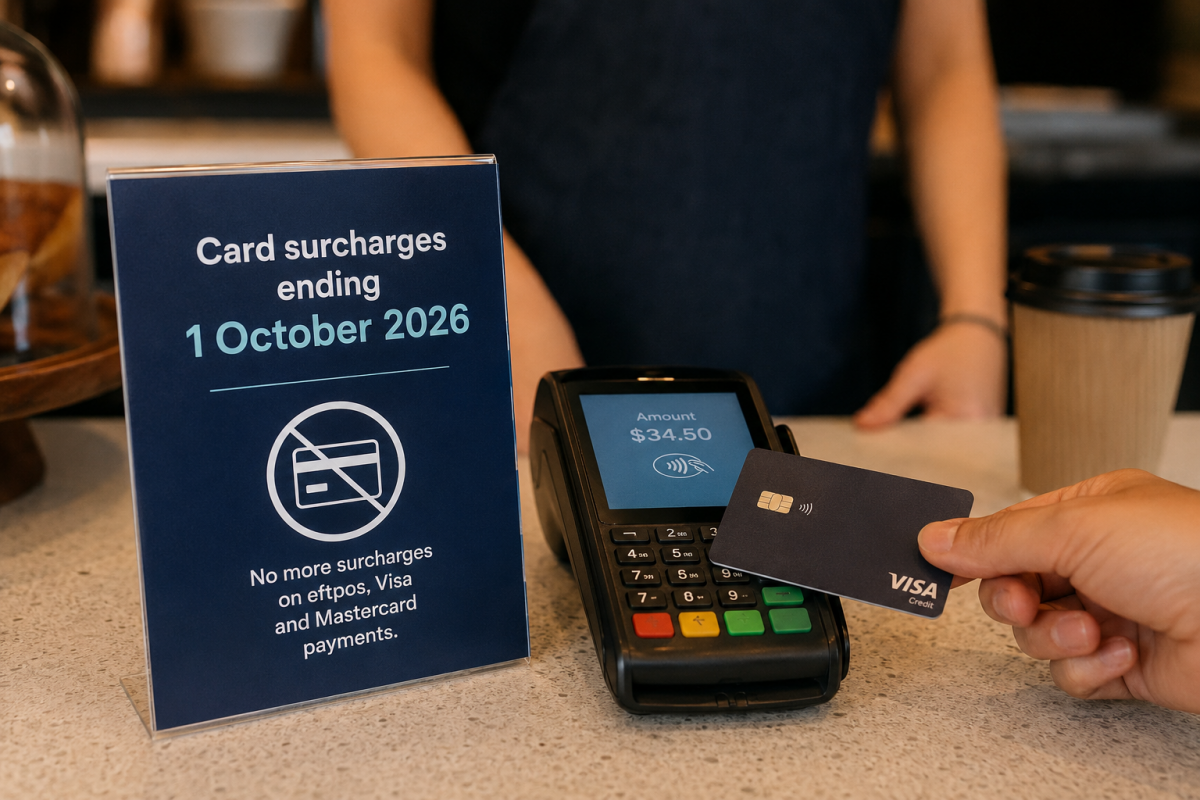
The Reserve Bank of Australia (RBA) has announced a significant reform that will reshape the way businesses process payments. From 1 October 2026, all surcharges on credit and debit card payments made through eftpos, Visa, and Mastercard will be prohibited across Australia.
For many businesses, card surcharges have become a common way to recover merchant payment costs. However, these new regulations aim to simplify pricing, improve transparency, and reduce payment costs across the economy.
If your business currently applies card surcharges, now is the time to start preparing.
Why Is the RBA Banning Card Surcharges?
According to the RBA, Australian consumers pay approximately $1.6 billion annually in card surcharges. At the same time, businesses incur even greater costs when accepting electronic payments.
The reform package is designed to:
- Eliminate unexpected checkout fees for consumers
- Reduce overall payment processing costs for businesses
- Improve transparency in the payments industry
- Encourage competition among payment providers
- Create a simpler and fairer pricing system
The RBA estimates that merchant payment costs could fall by approximately $910 million per year, with small businesses expected to benefit the most.
What Is Changing From 1 October 2026?
The new payment reforms consist of three key changes.
1. Card Surcharges Will Be Banned
From 1 October 2026, businesses will no longer be permitted to charge additional fees for payments made using:
- eftpos
- Visa
- Mastercard
- Related payment networks
This applies whether customers pay:
- In-store
- Online
- Through mobile wallets
- Via integrated payment systems
Customers must see a single final price without additional card payment charges being added at checkout.
2. Lower Interchange Fees
Interchange fees are wholesale charges exchanged between financial institutions when card payments are processed.
Under the new reforms:
- Existing fee caps will be reduced
- New limits will apply to foreign-issued cards
- Payment acceptance costs should decrease for merchants
Lower interchange fees are expected to reduce the overall cost of accepting card payments, helping businesses offset the loss of surcharge revenue.
3. Increased Fee Transparency
Banks, payment providers, and card schemes will be required to provide clearer information regarding:
- Merchant service fees
- Processing costs
- Fee structures
- Provider margins
Payment providers must also demonstrate how wholesale fee reductions are being passed on to businesses.
This increased transparency should make it easier for business owners to compare providers, negotiate better rates, and make informed decisions about their payment systems.
The reforms will be supported by oversight from the Australian Competition and Consumer Commission (ACCC) and guidance from the Australian Small Business and Family Enterprise Ombudsman.
How Businesses Should Prepare for the Card Surcharge Ban
Although the changes do not take effect until October 2026, businesses should begin reviewing their payment arrangements well in advance.
Review Your Merchant Fees
Start by examining your merchant statements and identifying:
- Current card acceptance costs
- Monthly processing fees
- Revenue generated from surcharges
- The overall impact on business margins
If surcharges currently help offset payment processing costs, you may need to review your pricing strategy to maintain profitability.
Speak With Your Payment Provider
The upcoming reforms create an opportunity to revisit your arrangements with your payment provider. As interchange fees are expected to decrease and fee transparency increases, businesses may be able to negotiate lower merchant service fees, more competitive pricing plans, or upgraded payment technology. Small businesses, which often pay higher effective processing rates, may stand to benefit the most from these discussions.
Update Your Pricing and POS Systems
Before the implementation date, businesses will need to remove:
- Card surcharge notices
- Checkout surcharge settings
- Automatic percentage-based fees
- Separate payment processing charges
All displayed prices must become fully inclusive.
Review both physical and online sales channels to ensure compliance with the new requirements.
Factor the Changes Into Cash Flow Planning
While lower merchant costs may not be immediate, many businesses are expected to experience savings during the 2026–27 financial year.
Industries that process large volumes of small transactions may see the greatest impact, including:
- Cafés
- Restaurants
- Retail stores
- Trade businesses
- Service-based businesses
Now is a good time to update budgets and financial forecasts to account for the expected changes.
Monitor Customer Payment Behaviour
The removal of surcharges may encourage more customers to choose card payments rather than cash. This could improve convenience, speed up transactions, and reduce the need for cash handling. However, businesses should continue monitoring their payment costs as customer behavior changes to ensure any increase in card usage does not offset the savings generated by lower merchant fees.
The Broader Impact on Australian Businesses
Ultimately, this reform creates a more level playing field across the Australian economy.
For businesses that never charged a surcharge will immediately benefit from lower underlying merchant fees, boosting your profitability.
For businesses that did charge a surcharge will enjoy far simpler daily operations, less administrative friction, and zero compliance risks.
Over time, this regulatory shakeup is expected to drive intense competition among payment providers, paving the way for superior financial products and even lower fees across the market. While banks may adjust secondary features like credit card rewards programs to offset their losses, the combined effort of the RBA and ACCC ensures savings are distributed fairly to businesses and consumers alike.
Final Thoughts
The end of card surcharges represents one of the most significant payment reforms in Australia in recent years.
For consumers, it means simpler pricing and fewer surprises at checkout. For businesses, it presents an opportunity to reduce complexity, improve operational efficiency, and potentially lower payment costs.
The key is preparation. Reviewing your payment arrangements now can help ensure a smooth transition before the 1 October 2026 deadline.
If you are unsure how these changes may affect your business, professional advice can help you assess merchant fees, evaluate pricing strategies, and identify opportunities to reduce costs before the new rules take effect.
Need Help?
By working with us as your professional tax accountant and mortgage broker, you can be confident that your loans are structured to protect your tax position, maximise deductions, and avoid costly mistakes, giving you greater peace of mind and more control over your financial future.
Pitt Martin Group is a firm of Chartered Accountants, providing services including taxation, accounting, business consulting, self-managed superannuation funds, auditing and mortgage & finance. We spend hundreds of hours each year on training and researching new tax laws to ensure our clients can maximize legitimate tax benefit. Our contact information are phone +61292213345 or email info@pittmartingroup.com.au. Pitt Martin Group is located in the convenient transportation hub of Sydney’s central business district. Our honours include the 2018 CPA NSW President’s Award for Excellence, the 2020 Australian Small Business Champion Award Finalist, the 2021 Australia’s well-known media ‘Accountants Daily’ the Accounting Firm of the Year Award Finalist and the 2022 Start-up Firm of the Year Award Finalist, and the 2023 Hong Kong-Australia Business Association Business Award Finalist.
Pitt Martin Group qualifications include over fifteen years of professional experience in accounting industry, Registered Australia Tax Agents, membership certification of the Chartered Accountants Australia and New Zealand (CA ANZ), certified External Examiner of the Law Societies of New South Wales, Victoria, and Western Australia Law Trust Accounts, membership certification of the Finance Brokers Association of Australia Limited (FBAA), Registered Agents of the Australian Securities and Investments Commission (ASIC), certified Advisor of accounting software such as XERO, QUICKBOOKS, MYOB, etc.
This content is for reference only and does not constitute advice on any individual or group’s specific situation. Any individual or group should take action only after consulting with professionals. Due to the timeliness of tax laws, we have endeavoured to provide timely and accurate information at the time of publication, but cannot guarantee that the content stated will remain applicable in the future. Please indicate the source when forwarding this content.
By Nora Pham @ Pitt Martin Tax
