
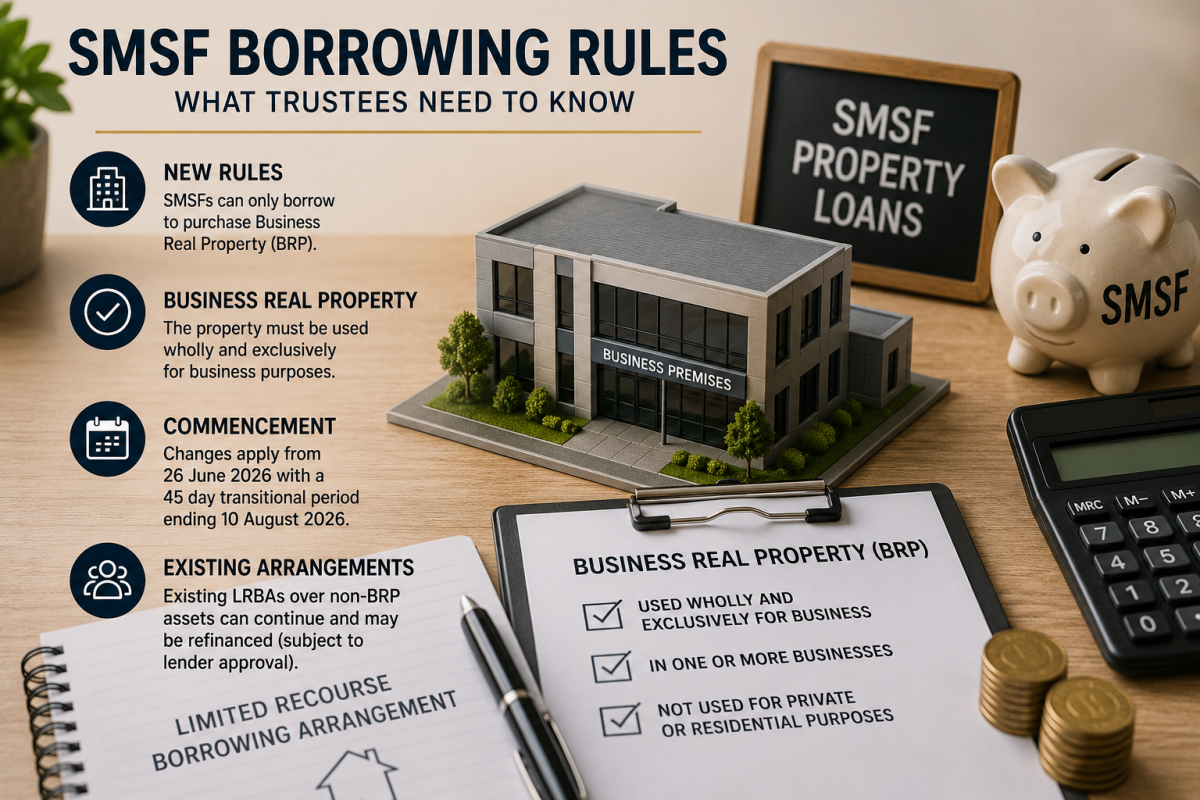
Significant changes to Self-Managed Super Fund (SMSF) borrowing rules have changed the types of property that SMSFs can acquire using a Limited Recourse Borrowing Arrangement (LRBA).
The changes became law on 26 June 2026 and, following a 45-day transitional period ending on 10 August 2026, generally restrict new SMSF property borrowing to property that meets the definition of business real property (BRP).
For SMSF trustees considering purchasing property through their super fund, understanding the new rules is essential before entering into a contract or arranging finance.
What Has Changed With SMSF Borrowing Rules?
SMSFs have traditionally been permitted to borrow in limited circumstances, including through an LRBA to acquire a single acquirable asset.
Property has been one of the most common assets purchased using these arrangements. Previously, there was no specific legislative restriction requiring the property acquired under an LRBA to be commercial or business property.
The new rules significantly narrow this position.
Where an SMSF uses borrowing to purchase real property under the new rules, the property generally needs to satisfy the business real property definition.
In practical terms, this means SMSF trustees considering an LRBA need to determine whether the property qualifies as business real property before proceeding with the purchase.
What Is Business Real Property for an SMSF?
Business real property is broadly real property that is used wholly and exclusively in one or more businesses.
An important point is that the test focuses primarily on how the property is actually used, rather than simply its zoning, appearance or original design.
This means the distinction is not necessarily as simple as:
- Residential property = not eligible
- Commercial property = eligible
The actual use of the property can be critical.
For example, a residential-style terrace house that is used wholly and exclusively as a medical practice may potentially satisfy the business real property requirements, despite originally being designed as a residence.
Conversely, a property that appears commercial may not necessarily qualify if it is not used wholly and exclusively for business purposes.
Can an SMSF Still Borrow to Buy Residential Property?
Under the new SMSF borrowing rules, an SMSF will generally not be able to use a new LRBA to purchase ordinary residential investment property that does not satisfy the business real property definition.
However, describing the changes simply as a “ban on SMSFs borrowing to buy residential property” can be misleading.
The relevant issue is the use of the property.
A residentially designed property may potentially qualify if it is used wholly and exclusively for business purposes and otherwise satisfies the business real property requirements.
Specialist advice should be obtained before relying on this treatment.
What About Mixed-Use Property?
Mixed-use properties require particular attention.
The business real property definition generally requires the property to be used wholly and exclusively for business purposes.
For example, consider a property on a single title containing:
- a retail shop on the ground floor; and
- a residential apartment upstairs.
Even though part of the property is clearly commercial, the residential component may prevent the entire property from satisfying the business real property definition.
SMSF trustees considering mixed-use properties should therefore obtain advice before signing a contract or entering into an LRBA.
When Did the New SMSF Borrowing Rules Start?
The changes became law on 26 June 2026.
However, the legislation provided a 45-day transitional period ending on 10 August 2026.
The transitional provisions may allow certain arrangements involving non-business real property that were already being implemented to continue, including circumstances where settlement takes place after 10 August 2026, provided the relevant arrangement to purchase the property was entered into on or before the transitional deadline.
Whether a particular transaction qualifies for the transitional treatment will depend on the specific circumstances and documentation.
SMSF trustees who entered into an arrangement involving non-BRP property before the deadline but had not completed settlement by 10 August 2026 should obtain specialist SMSF legal advice.
What Happens to Existing SMSF LRBAs?
Importantly, the new rules do not automatically require existing SMSF borrowing arrangements involving non-business real property to be unwound.
Existing LRBAs over non-BRP assets can generally continue under the updated rules.
The legislation also allows existing arrangements to be refinanced, subject to the relevant legislative requirements as well as lender availability and credit approval.
This is particularly important for SMSFs that already hold residential investment property through an LRBA.
Trustees should nevertheless obtain advice before refinancing or materially changing an existing borrowing arrangement, as changes to the structure or terms may have unintended SMSF compliance consequences.
Key Questions for SMSF Trustees
Before using an SMSF to borrow for a property purchase, trustees should consider:
- Does the property qualify as business real property?
- Is the property used wholly and exclusively for business purposes?
- Is there any residential or private use of the property?
- Does the proposed borrowing satisfy the LRBA requirements?
- Does the property meet the single acquirable asset rules?
- Is the purchase permitted under the SMSF’s trust deed and investment strategy?
- Are related-party acquisition and leasing rules relevant?
- If the arrangement began before 10 August 2026, do the transitional provisions apply?
These issues should ideally be reviewed before the SMSF signs a property contract, as correcting an incorrectly structured SMSF property transaction after signing can be difficult and costly.
Example: Residential Investment Property
An SMSF wants to borrow $600,000 under an LRBA to purchase an apartment that will be rented to an unrelated family as their home.
The apartment is being used for residential purposes rather than wholly and exclusively in a business.
Under the new borrowing restrictions, the property would generally not satisfy the business real property requirement for a new LRBA.
Example: Residential-Style Property Used as a Medical Practice
An SMSF is considering purchasing a terrace house that has been converted into medical consulting rooms.
Although the building was originally designed as residential accommodation, it is now used wholly and exclusively to operate a medical practice.
Subject to the particular circumstances and the other SMSF requirements being satisfied, the property may potentially qualify as business real property.
This illustrates why the new rules should not simply be viewed as a distinction between “residential” and “commercial” property.
What Should SMSF Trustees Do Before Borrowing?
SMSF property transactions involving LRBAs are already highly regulated, and the new borrowing restrictions add another important consideration.
Before entering into a new LRBA, trustees should obtain appropriate SMSF, legal, tax and financial advice to confirm that:
- the proposed property satisfies the business real property requirements;
- the LRBA has been correctly structured;
- the acquisition complies with the SIS Act and related SMSF rules;
- the fund’s trust deed and investment strategy permit the transaction; and
- any related-party transactions are appropriately structured.
This review should take place before contracts and borrowing documents are signed.
Frequently Asked Questions
Can an SMSF still borrow money to buy property?
Yes. SMSFs can still borrow in limited circumstances through an LRBA, but the new rules restrict the types of real property that can be acquired using new borrowing arrangements.
Can an SMSF borrow to buy a residential investment property?
Generally, a new LRBA cannot be used to acquire ordinary residential investment property that does not qualify as business real property.
Can an SMSF borrow to buy commercial property?
Potentially, yes. However, simply describing a property as “commercial” does not automatically mean it qualifies. The property needs to satisfy the relevant business real property requirements.
Can an SMSF buy business premises using an LRBA?
Potentially, yes, provided the property qualifies as business real property and all other LRBA, SMSF and superannuation law requirements are satisfied.
Can an SMSF keep residential property already purchased through an LRBA?
The updated rules allow existing LRBAs involving non-BRP assets to continue, subject to the applicable requirements.
Can an existing SMSF residential property loan be refinanced?
Existing arrangements may be refinanced under the updated rules, subject to the legislative requirements, lender availability and credit approval.
Does property zoning determine whether it is business real property?
Not necessarily. The business real property test focuses significantly on the use of the property, rather than simply its zoning, appearance or original design.
Need Advice About an SMSF Property Purchase?
The changes to SMSF borrowing rules make it increasingly important to review a proposed property acquisition before signing a contract or arranging finance.
If you are considering purchasing property through your SMSF, particularly using an LRBA, professional advice can help determine whether the property qualifies under the new rules and whether the proposed structure complies with Australia’s superannuation and tax requirements.
Need Help?
By working with us as your professional tax accountant and mortgage broker, you can be confident that your loans are structured to protect your tax position, maximise deductions, and avoid costly mistakes, giving you greater peace of mind and more control over your financial future.
Pitt Martin Group is a firm of Chartered Accountants, providing services including taxation, accounting, business consulting, self-managed superannuation funds, auditing and mortgage & finance. We spend hundreds of hours each year on training and researching new tax laws to ensure our clients can maximize legitimate tax benefit. Our contact information are phone +61292213345 or email info@pittmartingroup.com.au. Pitt Martin Group is located in the convenient transportation hub of Sydney’s central business district. Our honours include the 2018 CPA NSW President’s Award for Excellence, the 2020 Australian Small Business Champion Award Finalist, the 2021 Australia’s well-known media ‘Accountants Daily’ the Accounting Firm of the Year Award Finalist and the 2022 Start-up Firm of the Year Award Finalist, and the 2023 Hong Kong-Australia Business Association Business Award Finalist.
Pitt Martin Group qualifications include over fifteen years of professional experience in accounting industry, Registered Australia Tax Agents, membership certification of the Chartered Accountants Australia and New Zealand (CA ANZ), certified External Examiner of the Law Societies of New South Wales, Victoria, and Western Australia Law Trust Accounts, membership certification of the Finance Brokers Association of Australia Limited (FBAA), Registered Agents of the Australian Securities and Investments Commission (ASIC), certified Advisor of accounting software such as XERO, QUICKBOOKS, MYOB, etc.
This content is for reference only and does not constitute advice on any individual or group’s specific situation. Any individual or group should take action only after consulting with professionals. Due to the timeliness of tax laws, we have endeavoured to provide timely and accurate information at the time of publication, but cannot guarantee that the content stated will remain applicable in the future. Please indicate the source when forwarding this content.
