Skip to main content Skip to search

Archives for SMSF

SMSF investment strategy

自管养老金(SMSF)投资策略审查:受托人指南

每个自管养老金(Self-Managed Super Fund,简称SMSF)都必须制定投资策略。根据澳洲养老金法律,受托人必须结合基金的整体情况制定投资策略、定期审查,并确保实际投资活动符合该策略。

SMSF投资策略审查并不是简单的合规打勾程序,而是确保基金持有的资产仍然符合成员退休需求的重要过程。这也是SMSF审计师每年需要检查的事项之一。

法律并没有明确规定“定期审查”必须间隔多长时间。不过,至少每年审查一次是普遍接受的做法,也符合澳洲税务局(ATO)的预期。本文将介绍SMSF投资策略应该多久审查一次、投资策略必须涵盖哪些内容,以及如何记录审查过程,以确保基金符合相关合规要求。

为什么需要审查SMSF投资策略?

澳洲养老金法律要求SMSF受托人制定投资策略、定期审查,并确保基金按照投资策略运作。这是一项持续性的法律义务,而不是基金设立时完成一次就可以不再关注的工作。

无论采用哪种审查方式,受托人都必须能够向SMSF审计师证明,投资策略已经经过审查,并且相关决定已得到适当记录。

这些记录应当说明受托人决定进行哪些调整,或者说明经过审查后,为什么认为现有投资策略仍然适合基金。

如果缺乏相关书面证据,即使受托人实际上已经讨论或考虑过投资策略,审计师也可能无法确认审查已经完成。

SMSF投资策略应该多久审查一次?

一般建议至少每年审查一次SMSF投资策略。

部分受托人选择在新财年开始之前或开始时进行审查,另一些受托人则在审阅上一财年财务报表时同步审查投资策略。

这两种方式都可以,受托人应根据基金的实际情况选择合适的时间。关键是确保每年完成审查,并保留书面记录,以便审计师检查。

哪些情况下需要额外审查SMSF投资策略?

除了年度审查之外,当基金或市场环境发生重大变化时,也应重新评估投资策略,例如:

  • 金融市场出现明显调整或下跌;
  • 有新成员加入基金,或者现有成员退出基金;
  • 基金成员开始领取养老金(Pension)。

这些变化可能影响基金的投资风险、现金流需求及资产流动性,因此都是重新审查投资策略的重要时机。

SMSF投资策略包括哪些内容?

SMSF投资政策通常由两个主要部分组成。

第一部分是投资目标(Investment Objective)。

投资目标主要说明基金希望实现的投资成果,例如在一定期间内达到某个预期投资回报水平。

制定投资目标时,通常需要考虑基金成员的年龄、退休需求以及能够承受的投资风险。

第二部分是投资策略(Investment Strategy)。

投资策略主要说明基金将如何实现既定投资目标,例如规定不同资产类别的投资比例范围,或者列明基金计划持有的具体投资资产。

SMSF受托人在制定和审查投资策略时必须考虑哪些因素?

在审查SMSF投资策略时,受托人必须考虑以下事项:

  • 投资风险及预期回报:结合基金的投资目标及预计现金流需求,评估各项投资的风险和可能产生的回报。
  • 投资组合及分散风险:考虑基金整体投资资产的组成,以及投资过度集中、缺乏多元化可能带来的风险。
  • 资产流动性:根据基金预计的现金流需求,评估投资资产能否在需要时及时变现。
  • 履行债务及其他义务的能力:确保基金能够支付现有及未来可能产生的负债和其他财务义务。
  • 成员保险:考虑基金是否应该为一名或多名成员持有人寿保险、完全及永久伤残保险等适当的保险保障。

法律要求受托人考虑上述因素,但具体如何制定投资策略,仍需要根据基金的实际情况作出决定。

SMSF投资策略必须进行多元化投资吗?

SMSF受托人必须考虑投资多元化(Diversification),但这并不意味着法律强制要求每个SMSF都必须持有多种不同类型的资产。

许多SMSF仅持有一处房产和一个银行账户。对于某些基金而言,这样的投资组合可能完全合理。

关键在于受托人是否充分考虑并记录了投资集中的风险。

如果基金的投资高度集中,受托人应当记录:

  • 是否已经考虑投资多元化及相关风险;
  • 为什么缺乏多元化的投资组合仍然适合基金;
  • 为什么选择持有这些特定资产。

只要受托人能够根据基金的实际情况作出合理判断,并保留适当的书面记录,投资集中本身并不必然意味着违反SMSF合规要求。

SMSF必须为成员购买保险吗?

法律并没有强制要求SMSF必须为基金成员购买保险。

但是,受托人必须考虑成员是否需要保险保障,并记录相关考虑过程。

即使最终决定不购买任何保险,也应当在投资策略审查记录中说明已经考虑过保险问题及相关决定。

成员开始领取养老金后,SMSF投资策略需要如何调整?

当SMSF成员开始领取养老金时,通常需要重新审查投资策略,因为基金的资产流动性需求和投资结构可能发生明显变化。

在所有成员都处于退休前的资产积累阶段(Accumulation Phase)时,基金的日常支出通常比较容易预测,因此许多基金不需要保留大量现金。

但是,当成员开始提取退休福利,无论是通过定期养老金支付(Pension Payments)、一次性提取(Lump Sum),还是两者结合,基金的现金流、资产流动性以及现金储备就会变得更加重要。

有些SMSF受托人在临近财年结束时才发现,基金没有足够现金支付法定最低养老金金额。

造成这种情况可能有多种原因,但这通常意味着受托人需要重新评估现有投资策略是否仍然适当,以及基金持有的资产是否需要调整。

示例一:仅持有一处房产和一个银行账户的SMSF

假设某SMSF仅持有一处投资房产和一个银行账户。

在成员处于资产积累阶段时,这样的投资策略可能是合理的。但是,当成员进入退休领取阶段(Drawdown Phase)后,受托人就需要考虑原有策略是否仍然适用。

澳洲投资者通常偏好房地产投资,但这并不意味着房地产适合所有SMSF的退休需求。

如果房产产生的租金收入不足以满足成员的退休生活需求和法定最低养老金支付要求,基金可能需要调整投资安排。

同样的问题也可能出现在其他难以迅速变现的投资资产上,例如非上市公司股份或非上市信托权益。

示例二:SMSF成员开始领取养老金

某SMSF多年来一直处于资产积累阶段,基金主要投资于长期资产。

后来,一名成员开始领取账户型养老金(Account-Based Pension),基金必须每年向该成员支付至少法定最低金额的养老金。

受托人因此重新审查投资策略,评估基金新的现金流及流动性需求,并考虑调整投资组合或建立现金储备。

受托人同时记录了调整投资策略的原因及相关决定。

通过及时审查和调整投资策略,基金不仅能够满足相关合规要求,也能够确保有足够资金履行养老金支付义务。

SMSF受托人审查投资策略时应该检查哪些问题?

在完成SMSF投资策略审查之前,受托人可以检查以下事项:

  1. 今年是否已经至少审查过一次SMSF投资策略?
  2. 是否保存了书面记录,说明投资策略作出了哪些调整,或者为什么现有策略仍然适当?
  3. 是否考虑了投资风险、预期回报、投资多元化、资产流动性以及基金履行财务义务的能力?
  4. 如果基金投资高度集中,是否记录了为什么这种投资结构仍然适合基金?
  5. 是否考虑并记录了基金成员的保险需求?
  6. 是否发生了需要重新审查投资策略的重要变化,例如成员加入或退出、开始领取养老金,或者金融市场出现明显调整?
  7. 基金现有资产及现金流是否足以满足法定最低养老金支付要求和其他预计支出?

常见问题

SMSF必须每年审查投资策略吗?

澳洲养老金法律要求SMSF定期审查投资策略,但并没有明确规定固定的审查时间间隔。

至少每年审查一次是普遍接受的做法,也符合ATO的预期。

谁负责审查SMSF投资策略?

SMSF受托人负责审查投资策略。

受托人还必须能够向基金审计师证明,投资策略已经经过适当审查,并且相关决定已得到书面记录。

SMSF投资策略必须多元化吗?

不一定。

法律要求受托人考虑投资多元化,但并不强制要求所有SMSF都必须持有多种资产。

例如,仅持有一处房产和一个银行账户的基金,也可能具有合理的投资策略,前提是受托人已经充分考虑投资集中风险,并记录为什么该投资组合适合基金。

SMSF必须为成员购买保险吗?

不需要。

法律没有强制要求SMSF必须为成员购买保险,但受托人必须考虑成员的保险需求,并记录相关决定。

如果SMSF无法支付法定最低养老金金额怎么办?

这可能表明基金现有投资策略需要重新审查,特别是资产流动性、现金储备及投资组合是否仍然适合成员退休领取阶段的需求。

受托人应及时评估基金的现金流情况及投资安排,以确保基金能够履行养老金支付义务。

除年度审查外,什么时候还需要审查SMSF投资策略?

当发生可能影响基金投资风险或现金流需求的重要事件时,应考虑重新审查投资策略。

例如,金融市场出现明显调整、基金成员加入或退出,或者成员开始领取养老金。

需要协助?

如果您不确定现有SMSF投资策略是否仍然符合基金的实际情况,或者基金成员开始领取养老金等变化是否需要重新审查投资策略,皮特马丁会计师事务所可以协助您审阅和记录相关策略,评估投资多元化、资产流动性及成员保险等合规事项,并准备SMSF年度审计所需的证明文件。

作为悉尼专业税务会计师事务所,我们为SMSF受托人提供自管养老金会计、年度合规及投资策略审查相关服务,协助基金满足相关养老金法律及审计要求。

皮特马丁会计师事务所 Pitt Martin Group 是一家提供税务,会计,生意咨询,自管养老金,审计及贷款等综合性服务的经澳洲特许会计师协会认证的注册会计师事务所。我们每年会花上几百个小时去研究新的税法,以保证我们的客户可以最大化合理避税。我们的中文联系方式是 Robert Liu +61292213345 或邮件 info@pittmartingroup.com.au。皮特马丁会计师事务所Pitt Martin Group坐落在交通便利的悉尼市市中心,是一家拥有可以说中文合伙人的悉尼会计师事务所。我们的荣誉包括2018年CPA新州首席优秀奖, 2020年澳大利亚小生意年度冠军入围奖, 2021年澳洲知名媒体《每日会计师》年度最佳会计师事务所冠军入围奖,2022年最佳会计师事务所新人入围奖和2023香港澳大利亚商业协会最佳积极生意入围奖。

皮特马丁会计师事务所 Pitt Martin Group资质包括超过十五年的从业经验,澳大利亚税务注册代理,澳大利亚与新西兰特许会计师协会(CAANZ)会员,新州、维州和西澳律师协会信托账户 (Trust Account) 认证审计师,澳大利亚金融贷款经纪人协会(FBAA)执业认证会员,澳大利亚证券及投资委员会注册代理,XERO, QUICKBOOKS, MYOB等会计软件授权单位及认证顾问。

本文内容仅供参考,不构成对任何个人或团体的具体情况而形成建议。任何个人或团体应该在征求专业人士的意见后方可采取行动。由于税法的时效性,我们在发布时已致力于提供及时、准确的信息,但不能保证所称述的内容在今后任然可以适用。转发该文内容请注明出处。

By Robert Liu @ Pitt Martin Tax

Read more
SMSF investment strategy

SMSF investment strategy review: A Guide for Trustees

Every self-managed super fund (SMSF) must have an investment strategy, and superannuation law requires trustees to formulate it, review it regularly, and give effect to it, having regard to the whole of the circumstances of the fund. Reviewing your SMSF investment strategy is not a tick-a-box exercise. It is how you make sure the fund’s assets still match the members’ retirement needs, and it is one of the things your auditor will check each year.

The law does not set a fixed timeframe for what “review regularly” means. It is widely accepted, and consistent with the ATO’s expectations, that the review should happen at least once a year. This guide explains how often to review your investment strategy, what the strategy must cover, and how to document it so your fund stays compliant.

Why Review Your SMSF Investment Strategy?

Superannuation law requires SMSF trustees to formulate, regularly review, and give effect to an investment strategy for the fund. The obligation is ongoing, not a one-off task completed when the fund is set up.

Whichever way you approach it, you need to be able to show your fund’s auditor that you have reviewed the investment strategy and documented any decisions made. That documentation should record either the changes you decided were necessary, or your conclusion that the existing strategy remains appropriate. Without that evidence, the review effectively did not happen as far as the audit is concerned.

How Often Should an SMSF Investment Strategy Be Reviewed?

At a minimum, the review should take place at least annually.

Some trustees carry out the review leading up to, or at the start of, a new financial year. Others do it as part of reviewing the completed financial accounts from the previous year. Neither approach is right or wrong, and you should consider what suits your situation. The important point is that the review is done and documented each year, ready for the auditor.

When Else Should You Review Your Investment Strategy?

Beyond the annual review, there are other times when it is appropriate to revisit the strategy. These include when:

  • there is a market correction;
  • a member joins or leaves the fund; or
  • a member starts a pension in the fund.

Each of these events can change the fund’s risk profile, cashflow needs, or liquidity requirements, which is why they are natural triggers for a fresh look at the strategy.

What Goes Into an SMSF Investment Strategy?

An investment policy is generally made up of two parts.

The first is the investment objective. This outlines the fund’s goals and expected outcomes, for example achieving a certain level of return over a certain period. It usually takes into account the age of the members, their retirement needs, and their investment risk profile.

The second is the investment strategy itself. This outlines how the fund will achieve the stated objectives, for example by setting investment asset ranges or naming the specific assets the fund will hold.

What Must Trustees Consider in the Investment Strategy?

When reviewing the strategy, trustees must give consideration to:

  • the risk and likely return of the fund’s investments, having regard to the fund’s objectives and expected cashflow requirements;
  • the composition of the fund’s investments, including the risk that comes from inadequate diversification;
  • the liquidity of the investments, having regard to expected cashflow requirements;
  • the fund’s ability to discharge its existing and prospective liabilities; and
  • whether the fund should hold insurance cover for one or more members.

These points must be considered, but it is up to the trustees to decide how they apply them based on the circumstances of the fund.

Does an SMSF Need a Diversified Investment Strategy?

Diversification must be considered, but considering it does not mean you are required to have a diversified strategy.

Many funds hold just a property and a bank account, and that may be perfectly appropriate for those funds. The key is documentation. If the fund is concentrated, the trustees should record what consideration they gave to diversification, why the lack of diversification is appropriate, and why they chose those particular assets.

Do You Need Insurance for Members?

There is no legal requirement to hold insurance cover for the members of an SMSF. However, trustees do need to document that insurance has been considered, even if the decision is not to hold any.

How Does Starting a Pension Change Your Investment Strategy?

A member starting a pension is a common reason to review the strategy, because it usually changes the liquidity considerations and investment profile of the fund.

While members are all in the pre-retirement growth phase, expenses tend to be more predictable, and many funds do not need to hold large cash reserves. Once members reach the point of accessing their benefits, whether as pension payments, lump sums, or both, cashflow, liquidity, and a potential cash buffer become far more important.

It is not unusual, in the lead-up to the end of a financial year, for trustees to find they do not have the cash to satisfy even the minimum pension requirements. There can be several reasons for this, but it should raise questions about whether the current investment strategy is still appropriate and whether the fund’s asset holdings need to be reviewed.

Example: The One-Property, One-Bank-Account Fund

Consider a fund that holds a single property and a bank account. This may have been a reasonable strategy during the growth phase. In the drawdown phase, the question is whether it still works.

Australian investors often have an affinity for bricks and mortar, but that does not make property appropriate in every situation. If the rental income from the property cannot support the members’ retirement needs and minimum pension withdrawals, something has to change. The same issue applies to any asset that cannot be sold easily, such as holdings in unlisted companies or trusts.

Example: A Member Starts a Pension

A fund has operated for years with all members in the growth phase, holding mostly long-term assets. One member then starts an account-based pension and must be paid at least the minimum pension each year. The trustees review the strategy, consider the fund’s new cashflow and liquidity needs, adjust the asset mix or build a cash buffer, and document the reasons for the change. The review is what keeps the fund both compliant and able to meet its payments.

Key Questions for Trustees Reviewing Their Investment Strategy

Before signing off on the review, trustees can work through the following:

  • Have you reviewed the investment strategy at least once this year?
  • Does your documentation show either the changes made or that the existing strategy remains appropriate?
  • Have you considered risk, return, diversification, liquidity, and the fund’s ability to meet its liabilities?
  • If the fund is concentrated, have you documented why that is appropriate?
  • Have you documented whether insurance for members was considered?
  • Has anything changed, such as a member joining or leaving, a pension starting, or a market correction, that calls for a review?
  • Can the fund meet its minimum pension payments and expected cashflow from its current assets?

Frequently Asked Questions

Does an SMSF have to review its investment strategy every year?

The law says the strategy must be reviewed “regularly” without setting a fixed timeframe. At least once a year is widely accepted and consistent with the ATO’s expectations.

Who is responsible for reviewing the investment strategy?

The trustees are responsible. They must also be able to show the fund’s auditor that the review was carried out and documented.

Does an SMSF investment strategy have to be diversified?

No. Diversification must be considered, but a concentrated fund, such as one holding a property and a bank account, can be appropriate if the trustees document why.

Is insurance for members compulsory in an SMSF?

No. There is no requirement to hold insurance for members, but trustees must document that they considered it.

What happens if the fund cannot meet its minimum pension payments?

It is a warning sign that the investment strategy may need review, particularly around liquidity and whether the asset mix still suits the drawdown phase.

When should the strategy be reviewed outside the annual review?

After events such as a market correction, a member joining or leaving the fund, or a member starting a pension.

Need Help?

If you are unsure whether your SMSF’s investment strategy still suits the fund, or whether it needs reviewing after a change such as a member starting a pension, Pitt Martin Group can help you review and document your strategy, weigh up diversification, liquidity and insurance, and prepare the evidence your auditor will expect.

As Sydney tax accountants, we assist trustees with SMSF compliance, investment strategy reviews and practical superannuation advice.

Pitt Martin Group is a firm of Chartered Accountants, providing services including taxation, accounting, business consulting, self-managed superannuation funds, auditing and mortgage & finance. We spend hundreds of hours each year on training and researching new tax laws to ensure our clients can maximize legitimate tax benefit. Our contact information are phone +61292213345 or email info@pittmartingroup.com.au. Pitt Martin Group, Sydney tax accountants, is located in the convenient transportation hub of Sydney’s central business district. Our honours include the 2018 CPA NSW President’s Award for Excellence, the 2020 Australian Small Business Champion Award Finalist, the 2021 Australia’s well-known media ‘Accountants Daily’ the Accounting Firm of the Year Award Finalist and the 2022 Start-up Firm of the Year Award Finalist, and the 2023 Hong Kong-Australia Business Association Business Award Finalist.

Pitt Martin Group qualifications include over fifteen years of professional experience in accounting industry, Registered Australia Tax Agents, membership certification of the Chartered Accountants Australia and New Zealand (CA ANZ), certified External Examiner of the Law Societies of New South Wales, Victoria, and Western Australia Law Trust Accounts, membership certification of the Finance Brokers Association of Australia Limited (FBAA), Registered Agents of the Australian Securities and Investments Commission (ASIC), certified Advisor of accounting software such as XERO, QUICKBOOKS, MYOB, etc.

This content is for reference only and does not constitute advice on any individual or group’s specific situation. Any individual or group should take action only after consulting with professionals. Due to the timeliness of tax laws, we have endeavoured to provide timely and accurate information at the time of publication, but cannot guarantee that the content stated will remain applicable in the future. Please indicate the source when forwarding this content.


Read more
SMSF Property Valuation

自管养老金房产估值与2026财年审计指南

自管养老金(SMSF)房产估值是SMSF年度合规及审计工作的重要组成部分。对于许多SMSF受托人来说,房产是基金持有的最大资产之一,因此,在审计时采用准确并有充分证据支持的市场价值尤其重要。

与股票或现金不同,房产并没有一个可以在6月30日当天直接查询的实时市场价格。然而,SMSF的每项资产都必须在每个财年按照市场价值进行申报,基金审计师也需要看到清晰、客观的证据,以支持所采用的资产价值。

好消息是,如果受托人提前准备好适当的证明资料,而不是等到审计师提出要求后才匆忙寻找,SMSF房产审计通常会顺利得多。本指南将说明相关要求、审计师通常会查看哪些证据,以及受托人现在可以采取哪些措施,让2026财年的SMSF审计尽可能顺利。

为什么房产比其他SMSF资产更难审计?

澳洲养老金法律要求,SMSF的所有资产都必须在每年6月30日按照市场价值进行估值。对于拥有公开市场价格的资产,例如澳洲证券交易所(ASX)上市股票或管理基金,这通常比较简单,因为可以直接取得可靠的收盘价格。

房产则有所不同。房产没有每日公开报价,其价值可能每年出现较大变化,而且每一处房产都有其独特性。因此,受托人需要主动确定房产的市场价值,并能够提供充分的支持证据。这也是很多SMSF审计出现延误的地方。很多时候,问题并不在于房产估值本身,而是缺少或没有完整保存支持该估值的证明文件。

谁负责确定SMSF资产的价值?

受托人负责确定基金资产的市场价值,包括基金持有的房产。这项责任不能转交给会计师或审计师。审计师的职责是审查受托人采用的估值以及支持该估值的证据,而不是替受托人确定资产价值。

基金年度财务报表编制完成后,审计师会要求查看客观且具有支持性的证据,以了解受托人如何确定财务报表中所列的市场价值。如果无法提供足够的证据,审计师可能无法在没有保留意见的情况下完成审计,从而造成审计延误及额外成本。

SMSF资产什么时候需要进行估值?

SMSF资产(包括房产)必须在每年6月30日按照当日的市场价值进行估值,并用于基金的财务报表及SMSF年度申报。

即使您的2026财年SMSF审计可能要几个月之后才进行,所采用的估值仍然必须反映6月30日当天的市场价值。因此,在接近财年结束时、相关市场资料仍然较新的情况下收集估值证据,会比之后再重新寻找和整理相关资料容易得多。

SMSF资产是否应该使用独立估价师?

SMSF受托人可以选择聘请具有资质的独立估价师。在以下情况下尤其值得认真考虑:

  • 房产占SMSF资产总价值的较大比例;或者
  • 房产具有特殊性或其他原因导致其市场价值较难确定。

并不是每年都必须进行独立估价,但独立估价通常可以提供有力且具有说服力的估值依据,并减少审计过程中的不确定性。对于价值较高或较难估值的房产而言,与潜在的审计问题相比,聘请独立估价师所产生的费用往往相对较小。

哪些证据可以支持SMSF房产估值?

如果受托人选择不聘请独立估价师,通常需要使用来自多个来源的资料支持所采用的房产估值。仅依赖单一数据通常不足以构成充分的估值依据。

对于房产而言,可接受的估值证据通常包括:

  • 近期类似房产成交记录:通常至少需要三宗真正具有可比性的近期成交案例,例如房产面积和所在地区与SMSF持有的房产相近。
  • 房地产中介估价:最好能够同时列出该估价所依据的类似房产成交记录。
  • 商业房产净租金收益率:可以作为支持房产估值的辅助证据,但通常不足以单独作为估值依据。

澳洲税务局(ATO)在《SMSF资产估值指南》中提供了有关可接受估值方法及证明资料的指导,SMSF受托人可以将其作为重要参考。

示例:SMSF持有住宅房产的估值

某SMSF持有一套住宅公寓。受托人并没有每年委托专业估价师进行完整估价,而是收集了同一公寓楼及同一地区三套类似公寓的近期成交记录,同时取得当地房地产中介提供的书面估价,并在估价中引用这些成交案例。

这些资料共同为审计师提供了多个相互一致的证据来源,以支持财务报表中所采用的市场价值,因此审计可以在没有进一步房产估值查询的情况下顺利进行。

SMSF可以将房产出租给关联方吗?

如果SMSF持有的房产符合商业不动产(Business Real Property,BRP)的定义,该房产可以出租给基金成员经营的企业或基金的其他关联方。这是一种常见且合法的安排。例如,SMSF可以持有基金成员经营企业所使用的商业物业。

但是,允许将房产出租给关联方,并不意味着受托人可以自行决定收取任何金额的租金。任何与关联方之间的租赁安排都必须按照独立交易(arm’s length)的商业条款进行。

一个简单的判断方法是:如果租户是一名完全没有关联关系的第三方,双方是否仍然会同意租约中的每一项条款?如果租金低于市场水平,或者租赁条件对关联方明显更加优惠,该安排便可能无法满足独立交易原则的要求。

对于关联方租赁,审计师需要哪些证据?

为了证明关联方租赁安排符合独立交易原则,应向审计师提供以下资料:

  • 正式签署并以书面形式列明租赁条款的租约。
  • 租约开始时取得的租金估价,以证明租金符合当时的市场水平。
  • 证明实际租赁安排按照租约执行的资料,例如租金是否按时支付,以及实际支付金额是否与租约一致。
  • 如果之前的租赁期限已经到期,应提供租金已经按照最新市场水平重新调整的证据,并取得新的租金估价作为支持。

示例:将商业物业出租给关联方

某SMSF持有一处符合BRP定义的商业仓库,并将其出租给一家由基金成员拥有的公司。受托人保存了双方签署的正式租约,在租赁开始时取得了租金估价,并且能够提供持续按照租约规定支付租金的记录。

租约到期后,受托人重新取得新的租金估价,并根据当时的市场水平重新确定租金。由于相关租赁文件完整且资料保持更新,审计师能够较容易地确认该租赁安排符合独立交易原则。

SMSF受托人在审计前应该检查哪些问题?

在SMSF进行年度审计之前,建议受托人检查以下事项:

  1. 每一处房产是否已经按照6月30日的市场价值进行估值?
  2. 所采用的估值是否有来自多个来源的证据支持?
  3. 是否拥有至少三宗真正具有可比性的近期房产成交记录,或者当前的房产估价?
  4. 考虑到房产价值或复杂程度,是否应该取得独立专业估价?
  5. 如果房产出租给关联方,是否已经签订并妥善保存正式租约?
  6. 租约开始时是否取得了租金估价?
  7. 实际支付的租金是否与租约规定一致?
  8. 如果原租期已经到期,是否根据最新市场价值重新调整租金,并取得新的租金估价作为支持?

如何为2026财年SMSF资产审计做好准备?

虽然您的2026财年SMSF审计可能还需要几个月才会进行,但最顺利的审计通常来自受托人的提前准备。与其等到审计师提出资料要求后才开始准备,SMSF受托人可以提前采取以下措施:

  1. 在接近6月30日时收集类似房产成交记录及房产估价,确保相关市场资料具有时效性。
  2. 对于价值较高或较难估值的房产,确认是否有必要取得独立专业估价。
  3. 检查所有关联方租赁安排,确保租约文件完整、仍然有效,而且租赁条件符合当前市场水平。
  4. 将所有房产估值及租赁相关证据集中保存,以便审计师需要时可以及时提供。

提前完成这些准备工作,可以减少审计师提出的进一步查询,加快审计完成速度,并减少SMSF受托人在审计期间面临的压力。

常见问题

SMSF是否每年都必须对房产进行估值?

是的。SMSF的所有资产,包括房产,都必须在每年6月30日按照市场价值进行估值,并用于基金的年度财务报表及SMSF年度申报。

谁负责确定SMSF房产的市场价值?

SMSF受托人负责确定SMSF房产估值所采用的市场价值。审计师负责审查该估值以及相关支持证据,但审计师本身并不负责确定该价值。

SMSF每年都需要取得独立的房产估价吗?

不一定。受托人可以使用类似房产成交记录、房地产中介估价等资料支持所采用的市场价值。但是,如果房产占SMSF资产的较大比例,或者房产本身较难估值,则应考虑取得独立专业估价。

SMSF需要多少宗类似房产成交记录?

一般而言,通常需要至少三宗真正具有可比性的房产成交记录作为支持证据,例如面积和所在地区与SMSF持有的房产相近。

SMSF可以将房产出租给关联方吗?

可以,前提是该房产符合商业不动产(Business Real Property,BRP)的定义。租赁必须按照独立交易的商业条件进行,并应取得租金估价作为市场租金的支持证据。

SMSF向关联方收取多少租金?

租金必须反映市场价值,也就是在相同情况下,一名没有关联关系的第三方租户通常需要支付的租金。如果向关联方收取低于市场水平的租金,可能会产生SMSF合规问题。

SMSF受托人应该什么时候开始准备年度审计?

越早越好。在6月30日前后及时收集房产估值及租赁相关证据,而不是等到审计师正式要求资料后才开始准备,通常可以使之后的SMSF审计过程更加顺利。

需要协助?

皮特马丁会计师事务所可协助SMSF受托人处理自管养老金会计、年度合规及审计准备工作,包括审阅房产估值依据及关联方租赁文件。如果您正在准备2026财年的SMSF审计,或不确定现有的房产估值资料是否足以满足审计要求,欢迎联系我们的悉尼SMSF会计师获取专业协助。

皮特马丁会计师事务所 Pitt Martin Group 是一家提供税务,会计,生意咨询,自管养老金,审计及贷款等综合性服务的经澳洲特许会计师协会认证的注册会计师事务所。我们每年会花上几百个小时去研究新的税法,以保证我们的客户可以最大化合理避税。我们的中文联系方式是 Robert Liu +61292213345 或邮件 info@pittmartingroup.com.au。皮特马丁会计师事务所Pitt Martin Group坐落在交通便利的悉尼市市中心,是一家拥有可以说中文合伙人的悉尼会计师事务所。我们的荣誉包括2018年CPA新州首席优秀奖, 2020年澳大利亚小生意年度冠军入围奖, 2021年澳洲知名媒体《每日会计师》年度最佳会计师事务所冠军入围奖,2022年最佳会计师事务所新人入围奖和2023香港澳大利亚商业协会最佳积极生意入围奖。

皮特马丁会计师事务所 Pitt Martin Group资质包括超过十五年的从业经验,澳大利亚税务注册代理,澳大利亚与新西兰特许会计师协会(CAANZ)会员,新州、维州和西澳律师协会信托账户 (Trust Account) 认证审计师,澳大利亚金融贷款经纪人协会(FBAA)执业认证会员,澳大利亚证券及投资委员会注册代理,XERO, QUICKBOOKS, MYOB等会计软件授权单位及认证顾问。

本文内容仅供参考,不构成对任何个人或团体的具体情况而形成建议。任何个人或团体应该在征求专业人士的意见后方可采取行动。由于税法的时效性,我们在发布时已致力于提供及时、准确的信息,但不能保证所称述的内容在今后任然可以适用。转发该文内容请注明出处。

By Robert Liu @ Pitt Martin Tax

Read more
SMSF Property Valuation

SMSF Property Valuation and FY2026 Audit Guide

SMSF property valuation is an important part of the annual compliance and audit process for self-managed super funds. For many SMSF trustees, property is one of the largest assets the fund holds, making an accurate and well-supported market valuation particularly important at audit time.

Unlike shares or cash, property does not have a live market price you can simply look up on 30 June. Yet every SMSF asset must be reported at its market value each financial year, and your fund auditor needs to see clear, objective evidence supporting the value you have used.

The good news is that a property audit becomes far smoother when trustees prepare the right evidence in advance, rather than scrambling once the auditor asks for it. This guide explains what is required, what evidence your auditor will look for, and the steps trustees can take now to make the financial year 2026 (FY2026) audit as painless as possible.

Why Is Property Harder to Audit Than Other SMSF assets?

Superannuation law requires that all SMSF assets are valued at market value each 30 June. For assets with a ready market, such as ASX-listed shares or managed funds, this is straightforward, because a reliable closing price is readily available.

Property is different. There is no daily quoted price, values can move significantly from year to year, and each property is unique. Because of this, trustees need to actively determine the market value and be able to back it up with supportable evidence. This is where many audits slow down. Often the value itself is fine; it is the supporting documentation that is missing or incomplete.

Who Is Responsible for Valuing SMSF assets?

The trustees are responsible for determining the market value of the fund’s assets, including property. This responsibility cannot be handed to the accountant or the auditor. The auditor’s role is to review the valuation and the evidence behind it, not to set the value.

After the fund’s annual financial statements are prepared, the auditor will ask to see objective and supportable evidence showing how the trustees arrived at the reported market value. If that evidence is not available, the auditor may be unable to sign off without qualification, which can lead to delays and additional cost.

When Do SMSF Assets Need to Be Valued?

SMSF assets, including property, must be valued as at 30 June each year for the fund’s financial statements and annual return. Even though your FY2026 audit may not take place for several months, the valuation still needs to reflect the market value at that 30 June date. Gathering evidence close to year end, while it is current, is far easier than trying to reconstruct it later.

Should You Use an Independent Valuer for SMSF assets?

Trustees have the option to engage a qualified independent valuer, and it is worth seriously considering where:

  • the property represents a significant portion of the fund’s total value; or
  • the property is unusual or otherwise difficult to value.

An independent valuation is not compulsory in every year, but it provides strong, defensible evidence and can remove a lot of uncertainty from the audit. For high-value or hard-to-value properties, the cost of a valuer is often small compared with the risk of an audit issue.

What Evidence Supports an SMSF Assets Valuation?

Where trustees choose not to use an independent valuer, they generally need to support the valuation with evidence drawn from more than one source. A single data point is rarely enough on its own.

For property, acceptable evidence typically includes:

  • Recent comparable sales: generally at least three sales of genuinely comparable properties, similar in size and location to the fund’s property.
  • A real estate agent appraisal: ideally one that also sets out the comparable sales it is based on.
  • Net income yields for commercial property: useful supporting evidence, but generally not sufficient on its own.

The Australian Taxation Office (ATO) sets out helpful guidance on acceptable methods and evidence in its Guide to valuing SMSF assets, which is a useful reference point for trustees.

Example: Valuing a Residential Property Held by an SMSF

An SMSF owns a residential unit. Rather than commission a full valuation every year, the trustees gather three recent sales of comparable units in the same complex and suburb, along with a written appraisal from a local real estate agent that references those sales. Together, this gives the auditor multiple, consistent sources supporting the reported market value, so the audit proceeds without a valuation query.

Can an SMSF Rent Its Property to a Related Party?

Where an SMSF holds property that meets the business real property (BRP) definition, it is possible to lease that property to a business operated by a member or a related party of the fund. This is a common and legitimate arrangement. For example, a fund might own the premises its members’ business trades from.

However, the fact that a related-party lease is permitted does not mean trustees can charge whatever rent they like. Any lease with a related party must be on arm’s length (commercial) terms.

A simple way to test this is to ask: would every term of this lease be agreed to if the tenant were a completely unrelated third party? If the rent is below market, or the terms are unusually favourable, the arrangement is unlikely to satisfy the arm’s length requirement.

What Evidence Does an Auditor Need for a Related-Party Lease?

To demonstrate that a related-party leasing arrangement is on arm’s length terms, the auditor should be provided with:

  • A properly documented lease setting out the terms in writing.
  • A rent appraisal from the time the lease was first entered into, supporting the rent as a market rate.
  • Evidence that the arrangement is actually operating in line with the lease terms, such as rent being paid on time and in the agreed amount.
  • Evidence that, where a prior lease term has expired, the rent has been reset to market value and backed by a new rent appraisal.

Example: Leasing Business Premises to a Related Party

An SMSF owns a commercial warehouse that meets the BRP definition and leases it to a company owned by the fund’s members. The trustees keep a signed lease, obtained a rent appraisal when the lease commenced, and can show consistent rent payments matching the lease. When the term expired, they obtained a fresh appraisal and reset the rent to the current market rate. Because the paperwork is complete and current, the auditor can readily confirm the arrangement is on arm’s length terms.

Key Questions for SMSF Trustees Before Audit

Before your SMSF audit, it helps to work through the following:

  1. Has each property been valued at market value as at 30 June?
  2. Is the valuation supported by evidence from more than one source?
  3. Do you have at least three genuinely comparable recent sales, or a current appraisal?
  4. Would an independent valuation be appropriate given the property’s value or complexity?
  5. If the property is leased to a related party, is the lease properly documented?
  6. Was a rent appraisal obtained when the lease commenced?
  7. Is the rent being paid in line with the lease?
  8. Has the rent been reset to market value at the end of any expired term, supported by a new appraisal?

How to Prepare Your SMSF Assets for the FY2026 Audit

Although your FY2026 audit may still be some months away, the smoothest audits are the ones where trustees are proactive. Rather than waiting for the auditor’s request, trustees can:

  1. Gather comparable sales and appraisals close to 30 June, while the information is current.
  2. Confirm whether an independent valuation is warranted for any significant or hard-to-value property.
  3. Review related-party leases to ensure they are documented, current, and on market terms.
  4. Store all valuation and lease evidence in one place, ready to hand to the auditor.

Taking these steps early means fewer queries, faster sign-off, and less stress at audit time.

Frequently Asked Questions

Does an SMSF have to value its property every year?

Yes. All SMSF assets, including property, must be valued at market value each 30 June for the fund’s financial statements and annual return.

Who decides the market value of SMSF property?

The trustees are responsible for determining the market value used for an SMSF property valuation. The auditor reviews the value and the supporting evidence but does not set it.

Does an SMSF need an independent valuation of property each year?

Not necessarily. Trustees can support a valuation with evidence such as comparable sales and agent appraisals. However, an independent valuation should be considered where the property is a significant part of the fund or is difficult to value.

How many comparable sales does an SMSF need?

Generally at least three sales of genuinely comparable properties, similar in size and location, are expected as supporting evidence.

Can an SMSF lease property to a related party?

Yes, where the property meets the business real property definition. The lease must be on arm’s length (commercial) terms, supported by a rent appraisal.

What rent can an SMSF charge a related party?

The rent must reflect market value, meaning the same rent an unrelated third party would pay. Charging below-market rent to a related party can create compliance problems.

When should trustees start preparing for the audit?

As early as possible. Gathering valuation and lease evidence soon after 30 June, rather than waiting for the auditor’s request, makes for a much smoother audit.

Need Help?

Pitt Martin Group can assist SMSF trustees with SMSF accounting, annual compliance and audit preparation, including reviewing property valuation evidence and related-party lease documentation. If you are preparing for your FY2026 SMSF audit or are unsure whether your property valuation evidence is sufficient, contact our Sydney SMSF accountants for professional assistance.

Pitt Martin Group is a firm of Chartered Accountants, providing services including taxation, accounting, business consulting, self-managed superannuation funds, auditing and mortgage & finance. We spend hundreds of hours each year on training and researching new tax laws to ensure our clients can maximize legitimate tax benefit. Our contact information are phone +61292213345 or email info@pittmartingroup.com.au. Pitt Martin Group, Sydney tax accountants, is located in the convenient transportation hub of Sydney’s central business district. Our honours include the 2018 CPA NSW President’s Award for Excellence, the 2020 Australian Small Business Champion Award Finalist, the 2021 Australia’s well-known media ‘Accountants Daily’ the Accounting Firm of the Year Award Finalist and the 2022 Start-up Firm of the Year Award Finalist, and the 2023 Hong Kong-Australia Business Association Business Award Finalist.

Pitt Martin Group qualifications include over fifteen years of professional experience in accounting industry, Registered Australia Tax Agents, membership certification of the Chartered Accountants Australia and New Zealand (CA ANZ), certified External Examiner of the Law Societies of New South Wales, Victoria, and Western Australia Law Trust Accounts, membership certification of the Finance Brokers Association of Australia Limited (FBAA), Registered Agents of the Australian Securities and Investments Commission (ASIC), certified Advisor of accounting software such as XERO, QUICKBOOKS, MYOB, etc.

This content is for reference only and does not constitute advice on any individual or group’s specific situation. Any individual or group should take action only after consulting with professionals. Due to the timeliness of tax laws, we have endeavoured to provide timely and accurate information at the time of publication, but cannot guarantee that the content stated will remain applicable in the future. Please indicate the source when forwarding this content.

Read more
Changes to SMSF Borrowing Rules: New Restrictions on Property Purchases

SMSF借款规则重大变化:2026年新规对投资房有何影响?

自管养老金基金(Self-Managed Super Fund,SMSF)的借款规则已经发生重大变化,新规限制了SMSF通过有限追索权借款安排(Limited Recourse Borrowing Arrangement,LRBA)可以购买的房地产类型。

相关修改已于2026年6月26日正式成为法律。在截至2026年8月10日的45天过渡期结束后,SMSF通过新的借款安排购买房地产,一般需要该房产符合商业不动产(Business Real Property,BRP)的定义。

对于计划通过SMSF借款购买房地产的受托人来说,在签署购房合同或安排贷款之前了解这些新规定非常重要。

SMSF借款规则发生了什么变化?

一直以来,SMSF只能在特定和受限制的情况下借款,其中包括通过LRBA购买单一可收购资产(single acquirable asset)。

房地产一直是LRBA最常见的投资资产之一。过去,法律并没有特别规定通过LRBA购买的房地产必须属于商业物业或商业用途房地产。

新规定大幅收紧了这一规则。

根据新规定,如果SMSF通过借款购买房地产,该房地产通常需要符合商业不动产的定义。

实际上,这意味着SMSF受托人在考虑通过LRBA购买房地产之前,需要首先确定该房产是否符合商业不动产的相关要求。

什么是SMSF的商业不动产(Business Real Property)?

商业不动产一般是指完全并且专门用于一项或多项商业活动的房地产。

需要特别注意的是,这项测试主要关注房地产的实际用途,而不仅仅是该物业的土地规划用途(zoning)、外观或者最初的建筑设计用途。

因此,新规定并不能简单理解为:

  • 住宅物业 = 不符合条件
  • 商业物业 = 符合条件

房地产的实际使用方式可能是判断其是否符合规定的关键因素。

例如,一栋原本按照住宅用途设计的联排住宅,如果目前已经完全用于经营医疗诊所,则即使它最初属于住宅设计,也可能符合商业不动产的相关要求。

相反,一项看起来属于商业物业的房地产,如果并非完全并且专门用于商业用途,也不一定符合商业不动产的定义。

SMSF现在还能借款购买住宅物业吗?

根据新的SMSF借款规则,如果普通住宅投资物业不符合商业不动产的定义,SMSF一般不能通过新的LRBA借款购买该物业。

不过,将新规定简单描述为“禁止SMSF借款购买住宅物业”并不完全准确。

真正需要考虑的关键因素是房地产的实际用途。

即使一项物业在建筑设计上属于住宅,如果它实际上完全并且专门用于商业用途,并且符合商业不动产的其他要求,也有可能符合新规定。

在依赖这一规定进行投资之前,应当取得专业意见。

混合用途物业怎么办?

对于混合用途物业,需要特别谨慎。

商业不动产的定义通常要求房地产完全并且专门用于商业用途。

例如,一项位于同一个产权(single title)下的物业包括:

  • 一楼的零售商铺;以及
  • 楼上的住宅公寓。

虽然其中一部分明显属于商业用途,但住宅部分可能导致整个物业无法满足商业不动产的定义。

因此,如果SMSF受托人考虑购买混合用途物业,应当在签署购房合同或签订LRBA之前取得专业意见。

新的SMSF借款规则什么时候开始实施?

相关修改已于2026年6月26日正式成为法律。

不过,法律同时提供了45天的过渡期,过渡期于2026年8月10日结束。

过渡性规定可能允许某些已经开始实施、但涉及非商业不动产的安排继续进行。例如,即使物业在2026年8月10日之后才完成交割,只要相关物业购买安排是在过渡期截止日期之前,即2026年8月10日或之前订立的,就有可能符合过渡性规定。

某一项具体交易是否符合过渡性规定,需要根据实际情况以及相关法律文件进行判断。

如果SMSF受托人在截止日期之前已经订立了涉及非BRP物业的安排,但截至2026年8月10日仍未完成交割,建议取得专业SMSF法律意见。

现有SMSF的LRBA会受到什么影响?

需要特别注意的是,新规定并不会自动要求SMSF终止现有的、涉及非商业不动产的借款安排。

根据更新后的规定,现有的非BRP资产LRBA一般可以继续保留。

新规定同时允许现有借款安排进行再融资,但需要符合相关法律规定,同时取决于贷款机构是否愿意提供贷款以及是否通过信贷审批。

这一点对于目前已经通过LRBA持有住宅投资物业的SMSF尤其重要。

不过,在对现有SMSF贷款进行再融资或者对借款安排作出重大修改之前,受托人仍然应该取得专业意见,因为借款结构或者贷款条款的改变可能产生意外的SMSF合规问题。

SMSF受托人在借款前应该考虑哪些问题?

在SMSF通过借款购买房地产之前,受托人应考虑以下问题:

  1. 该房地产是否符合商业不动产的定义?
  2. 该房地产是否完全并且专门用于商业用途?
  3. 该房地产是否存在任何住宅用途或者私人用途?
  4. 拟议的借款安排是否符合LRBA的相关要求?
  5. 该房地产是否符合单一可收购资产规则?
  6. SMSF的信托契约(Trust Deed)和投资策略是否允许进行该项投资?
  7. 是否涉及关联方资产收购或者关联方租赁规定?
  8. 如果相关安排是在2026年8月10日之前开始的,是否符合过渡性规定?

最好在SMSF签署房地产购买合同之前完成上述事项的审查,因为如果SMSF的房地产交易结构存在问题,在合同签署之后再进行修改可能会非常困难,并且产生额外成本。

案例一:住宅投资物业

假设一个SMSF计划通过LRBA借款60万澳元购买一套公寓,并将该公寓出租给一个与SMSF没有关联的家庭作为住宅使用。

该公寓的实际用途是住宅,而不是完全并且专门用于商业活动。

根据新的借款限制,该物业一般无法满足新LRBA所要求的商业不动产条件。

因此,SMSF一般不能通过新的LRBA借款购买这种普通住宅投资物业。

案例二:作为医疗诊所使用的住宅型物业

假设一个SMSF计划购买一栋联排住宅,但该物业已经被改造成医疗诊所。

虽然该建筑最初是按照住宅用途设计的,但目前整个物业完全并且专门用于经营医疗业务。

根据具体情况,并且在满足其他SMSF相关规定的前提下,该物业有可能符合商业不动产的定义。

这个案例说明,新规定不能简单理解为“住宅物业”和“商业物业”之间的区别。

真正重要的是物业的实际使用方式,以及是否满足商业不动产的法律定义。

SMSF受托人在借款买房之前应该做什么?

SMSF通过LRBA进行房地产投资本身已经受到严格监管,而新的借款限制又增加了一项非常重要的合规要求。

在订立新的LRBA之前,受托人应该取得适当的SMSF、法律、税务以及财务方面的专业意见,以确认:

  • 拟购买的房地产符合商业不动产的相关要求;
  • LRBA的法律结构设置正确;
  • 房地产收购符合《Superannuation Industry (Supervision) Act》及其他SMSF相关规定;
  • SMSF的信托契约和投资策略允许进行该项交易;以及
  • 如果涉及关联方交易,相关安排已经按照SMSF法律要求进行适当设置。

这些审查最好在签署购房合同以及贷款文件之前完成。

常见问题

SMSF现在还可以借钱购买房地产吗?

可以。SMSF仍然可以在有限的情况下通过LRBA借款,但是新规定限制了通过新的借款安排可以购买的房地产类型。

SMSF还可以借款购买住宅投资物业吗?

一般来说,如果普通住宅投资物业不符合商业不动产的定义,SMSF不能通过新的LRBA借款购买该物业。

SMSF可以借款购买商业物业吗?

有可能。但是,仅仅将一项物业称为“商业物业”并不代表它一定符合规定。该物业仍然需要满足商业不动产的相关法律要求。

SMSF可以通过LRBA购买自己的商业经营场所吗?

有可能,前提是该物业符合商业不动产的定义,同时满足LRBA、SMSF以及其他养老金法律的相关规定。

SMSF可以继续持有以前通过LRBA购买的住宅物业吗?

根据更新后的规定,现有涉及非BRP资产的LRBA可以继续存在,但仍需要符合相关法律要求。

现有SMSF住宅物业贷款可以进行再融资吗?

现有借款安排可以在符合相关法律规定的情况下进行再融资,但同时取决于贷款机构是否愿意提供融资以及是否通过其信贷审批。

房地产的土地规划用途(zoning)是否决定它属于商业不动产?

不一定。商业不动产的判断重点在很大程度上取决于房地产的实际使用方式,而不仅仅取决于土地规划用途、物业外观或者最初的建筑设计用途。

正在考虑通过SMSF购买房地产?

SMSF借款规则的变化意味着,在签署房地产购买合同或者安排贷款之前,对拟议交易进行审查变得更加重要。

如果您正在考虑通过SMSF购买房地产,特别是计划使用LRBA借款,提前取得专业意见可以帮助您判断相关房地产是否符合新规定,以及拟议的投资和借款结构是否符合澳大利亚养老金及税务法律要求。

需要协助?

与我们这样的专业税务会计师和贷款经纪人合作,您可以放心,我们的团队可以提供针对性建议,确保贷款结构既能保护您的税务最大化扣除,同时避免错误的风险,从而让您更加安心,并更好地规划财务。

皮特马丁会计师事务所 Pitt Martin Group 是一家提供税务,会计,生意咨询,自管养老金,审计及贷款等综合性服务的经澳洲特许会计师协会认证的注册会计师事务所。我们每年会花上几百个小时去研究新的税法,以保证我们的客户可以最大化合理避税。我们的中文联系方式是 Robert Liu +61292213345 或邮件 info@pittmartingroup.com.au。皮特马丁会计师事务所Pitt Martin Group坐落在交通便利的悉尼市市中心,是一家拥有可以说中文合伙人的会计师事务所。我们的荣誉包括2018年CPA新州首席优秀奖, 2020年澳大利亚小生意年度冠军入围奖, 2021年澳洲知名媒体《每日会计师》年度最佳会计师事务所冠军入围奖,2022年最佳会计师事务所新人入围奖和2023香港澳大利亚商业协会最佳积极生意入围奖。

皮特马丁会计师事务所 Pitt Martin Group资质包括超过十五年的从业经验,澳大利亚税务注册代理,澳大利亚与新西兰特许会计师协会(CAANZ)会员,新州、维州和西澳律师协会信托账户 (Trust Account) 认证审计师,澳大利亚金融贷款经纪人协会(FBAA)执业认证会员,澳大利亚证券及投资委员会注册代理,XERO, QUICKBOOKS, MYOB等会计软件授权单位及认证顾问。

本文内容仅供参考,不构成对任何个人或团体的具体情况而形成建议。任何个人或团体应该在征求专业人士的意见后方可采取行动。由于税法的时效性,我们在发布时已致力于提供及时、准确的信息,但不能保证所称述的内容在今后任然可以适用。转发该文内容请注明出处。

By Robert Liu @ Pitt Martin Tax

Read more
Changes to SMSF Borrowing Rules: New Restrictions on Property Purchases

Changes to SMSF Borrowing Rules: New Restrictions on Property Purchases

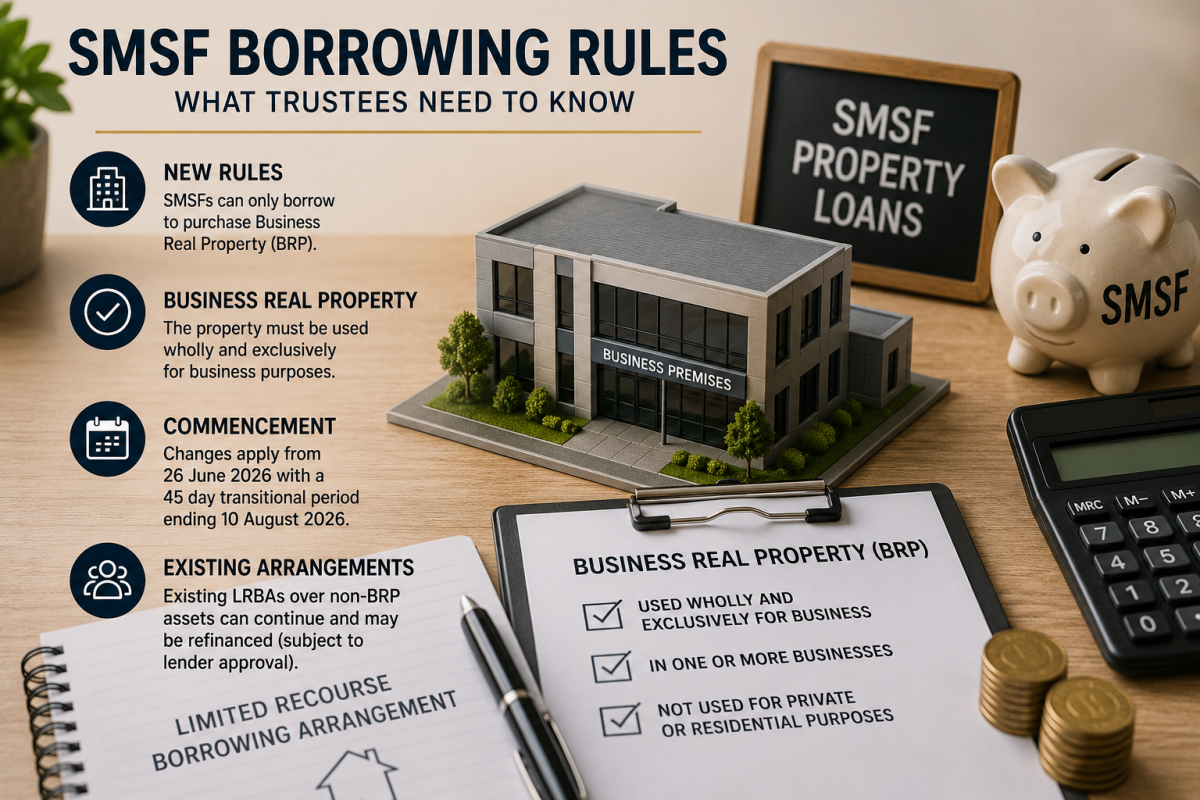
Significant changes to Self-Managed Super Fund (SMSF) borrowing rules have changed the types of property that SMSFs can acquire using a Limited Recourse Borrowing Arrangement (LRBA).

The changes became law on 26 June 2026 and, following a 45-day transitional period ending on 10 August 2026, generally restrict new SMSF property borrowing to property that meets the definition of business real property (BRP).

For SMSF trustees considering purchasing property through their super fund, understanding the new rules is essential before entering into a contract or arranging finance.

What Has Changed With SMSF Borrowing Rules?

SMSFs have traditionally been permitted to borrow in limited circumstances, including through an LRBA to acquire a single acquirable asset.

Property has been one of the most common assets purchased using these arrangements. Previously, there was no specific legislative restriction requiring the property acquired under an LRBA to be commercial or business property.

The new rules significantly narrow this position.

Where an SMSF uses borrowing to purchase real property under the new rules, the property generally needs to satisfy the business real property definition.

In practical terms, this means SMSF trustees considering an LRBA need to determine whether the property qualifies as business real property before proceeding with the purchase.

What Is Business Real Property for an SMSF?

Business real property is broadly real property that is used wholly and exclusively in one or more businesses.

An important point is that the test focuses primarily on how the property is actually used, rather than simply its zoning, appearance or original design.

This means the distinction is not necessarily as simple as:

  • Residential property = not eligible
  • Commercial property = eligible

The actual use of the property can be critical.

For example, a residential-style terrace house that is used wholly and exclusively as a medical practice may potentially satisfy the business real property requirements, despite originally being designed as a residence.

Conversely, a property that appears commercial may not necessarily qualify if it is not used wholly and exclusively for business purposes.

Can an SMSF Still Borrow to Buy Residential Property?

Under the new SMSF borrowing rules, an SMSF will generally not be able to use a new LRBA to purchase ordinary residential investment property that does not satisfy the business real property definition.

However, describing the changes simply as a “ban on SMSFs borrowing to buy residential property” can be misleading.

The relevant issue is the use of the property.

A residentially designed property may potentially qualify if it is used wholly and exclusively for business purposes and otherwise satisfies the business real property requirements.

Specialist advice should be obtained before relying on this treatment.

What About Mixed-Use Property?

Mixed-use properties require particular attention.

The business real property definition generally requires the property to be used wholly and exclusively for business purposes.

For example, consider a property on a single title containing:

  • a retail shop on the ground floor; and
  • a residential apartment upstairs.

Even though part of the property is clearly commercial, the residential component may prevent the entire property from satisfying the business real property definition.

SMSF trustees considering mixed-use properties should therefore obtain advice before signing a contract or entering into an LRBA.

When Did the New SMSF Borrowing Rules Start?

The changes became law on 26 June 2026.

However, the legislation provided a 45-day transitional period ending on 10 August 2026.

The transitional provisions may allow certain arrangements involving non-business real property that were already being implemented to continue, including circumstances where settlement takes place after 10 August 2026, provided the relevant arrangement to purchase the property was entered into on or before the transitional deadline.

Whether a particular transaction qualifies for the transitional treatment will depend on the specific circumstances and documentation.

SMSF trustees who entered into an arrangement involving non-BRP property before the deadline but had not completed settlement by 10 August 2026 should obtain specialist SMSF legal advice.

What Happens to Existing SMSF LRBAs?

Importantly, the new rules do not automatically require existing SMSF borrowing arrangements involving non-business real property to be unwound.

Existing LRBAs over non-BRP assets can generally continue under the updated rules.

The legislation also allows existing arrangements to be refinanced, subject to the relevant legislative requirements as well as lender availability and credit approval.

This is particularly important for SMSFs that already hold residential investment property through an LRBA.

Trustees should nevertheless obtain advice before refinancing or materially changing an existing borrowing arrangement, as changes to the structure or terms may have unintended SMSF compliance consequences.

Key Questions for SMSF Trustees

Before using an SMSF to borrow for a property purchase, trustees should consider:

  1. Does the property qualify as business real property?
  2. Is the property used wholly and exclusively for business purposes?
  3. Is there any residential or private use of the property?
  4. Does the proposed borrowing satisfy the LRBA requirements?
  5. Does the property meet the single acquirable asset rules?
  6. Is the purchase permitted under the SMSF’s trust deed and investment strategy?
  7. Are related-party acquisition and leasing rules relevant?
  8. If the arrangement began before 10 August 2026, do the transitional provisions apply?

These issues should ideally be reviewed before the SMSF signs a property contract, as correcting an incorrectly structured SMSF property transaction after signing can be difficult and costly.

Example: Residential Investment Property

An SMSF wants to borrow $600,000 under an LRBA to purchase an apartment that will be rented to an unrelated family as their home.

The apartment is being used for residential purposes rather than wholly and exclusively in a business.

Under the new borrowing restrictions, the property would generally not satisfy the business real property requirement for a new LRBA.

Example: Residential-Style Property Used as a Medical Practice

An SMSF is considering purchasing a terrace house that has been converted into medical consulting rooms.

Although the building was originally designed as residential accommodation, it is now used wholly and exclusively to operate a medical practice.

Subject to the particular circumstances and the other SMSF requirements being satisfied, the property may potentially qualify as business real property.

This illustrates why the new rules should not simply be viewed as a distinction between “residential” and “commercial” property.

What Should SMSF Trustees Do Before Borrowing?

SMSF property transactions involving LRBAs are already highly regulated, and the new borrowing restrictions add another important consideration.

Before entering into a new LRBA, trustees should obtain appropriate SMSF, legal, tax and financial advice to confirm that:

  • the proposed property satisfies the business real property requirements;
  • the LRBA has been correctly structured;
  • the acquisition complies with the SIS Act and related SMSF rules;
  • the fund’s trust deed and investment strategy permit the transaction; and
  • any related-party transactions are appropriately structured.

This review should take place before contracts and borrowing documents are signed.

Frequently Asked Questions

Can an SMSF still borrow money to buy property?

Yes. SMSFs can still borrow in limited circumstances through an LRBA, but the new rules restrict the types of real property that can be acquired using new borrowing arrangements.

Can an SMSF borrow to buy a residential investment property?

Generally, a new LRBA cannot be used to acquire ordinary residential investment property that does not qualify as business real property.

Can an SMSF borrow to buy commercial property?

Potentially, yes. However, simply describing a property as “commercial” does not automatically mean it qualifies. The property needs to satisfy the relevant business real property requirements.

Can an SMSF buy business premises using an LRBA?

Potentially, yes, provided the property qualifies as business real property and all other LRBA, SMSF and superannuation law requirements are satisfied.

Can an SMSF keep residential property already purchased through an LRBA?

The updated rules allow existing LRBAs involving non-BRP assets to continue, subject to the applicable requirements.

Can an existing SMSF residential property loan be refinanced?

Existing arrangements may be refinanced under the updated rules, subject to the legislative requirements, lender availability and credit approval.

Does property zoning determine whether it is business real property?

Not necessarily. The business real property test focuses significantly on the use of the property, rather than simply its zoning, appearance or original design.

Need Advice About an SMSF Property Purchase?

The changes to SMSF borrowing rules make it increasingly important to review a proposed property acquisition before signing a contract or arranging finance.

If you are considering purchasing property through your SMSF, particularly using an LRBA, professional advice can help determine whether the property qualifies under the new rules and whether the proposed structure complies with Australia’s superannuation and tax requirements.

Need Help?

By working with us as your professional tax accountant and mortgage broker, you can be confident that your loans are structured to protect your tax position, maximise deductions, and avoid costly mistakes, giving you greater peace of mind and more control over your financial future.

Pitt Martin Group is a firm of Chartered Accountants, providing services including taxation, accounting, business consulting, self-managed superannuation funds, auditing and mortgage & finance. We spend hundreds of hours each year on training and researching new tax laws to ensure our clients can maximize legitimate tax benefit. Our contact information are phone +61292213345 or email info@pittmartingroup.com.au. Pitt Martin Group is located in the convenient transportation hub of Sydney’s central business district. Our honours include the 2018 CPA NSW President’s Award for Excellence, the 2020 Australian Small Business Champion Award Finalist, the 2021 Australia’s well-known media ‘Accountants Daily’ the Accounting Firm of the Year Award Finalist and the 2022 Start-up Firm of the Year Award Finalist, and the 2023 Hong Kong-Australia Business Association Business Award Finalist.

Pitt Martin Group qualifications include over fifteen years of professional experience in accounting industry, Registered Australia Tax Agents, membership certification of the Chartered Accountants Australia and New Zealand (CA ANZ), certified External Examiner of the Law Societies of New South Wales, Victoria, and Western Australia Law Trust Accounts, membership certification of the Finance Brokers Association of Australia Limited (FBAA), Registered Agents of the Australian Securities and Investments Commission (ASIC), certified Advisor of accounting software such as XERO, QUICKBOOKS, MYOB, etc.

This content is for reference only and does not constitute advice on any individual or group’s specific situation. Any individual or group should take action only after consulting with professionals. Due to the timeliness of tax laws, we have endeavoured to provide timely and accurate information at the time of publication, but cannot guarantee that the content stated will remain applicable in the future. Please indicate the source when forwarding this content.

Read more