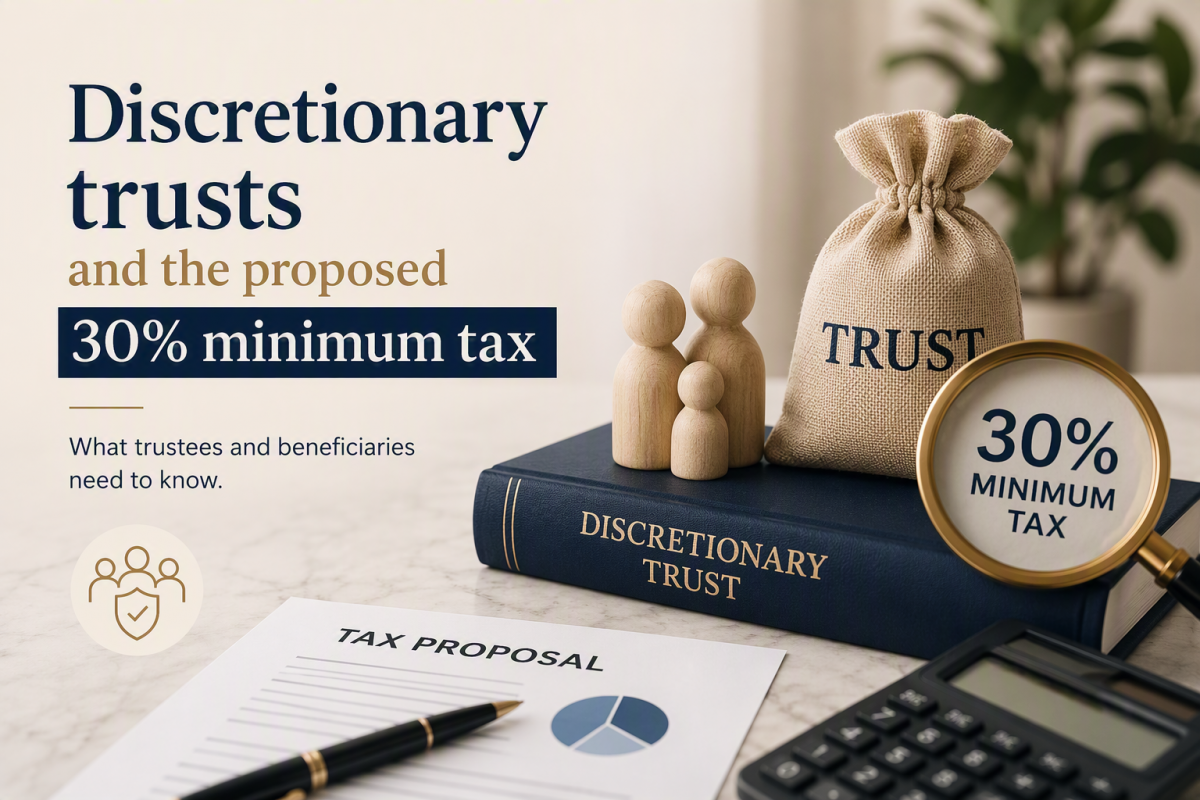
The Australian Government has proposed a significant change to the taxation of discretionary trusts, commonly known as family trusts.
From 1 July 2028, the Government proposes to introduce a 30% minimum tax on the taxable income of discretionary trusts, subject to certain exclusions. The Government has also proposed a three-year rollover period from 1 July 2027 to help eligible businesses and taxpayers restructure their affairs if required.
While discretionary trusts remain a common structure for Australian families, business owners and investors, the proposed changes may affect the way some trusts distribute income and manage their tax affairs.
It is important to note that the proposed 30% minimum tax is not yet law. Treasury is consulting on the design and implementation of the proposed reforms, so some details may change before legislation is introduced.
What Is a Discretionary Trust?
A discretionary trust is a trust structure where the trustee generally has discretion over how trust income and capital are distributed among eligible beneficiaries.
Discretionary trusts are commonly used in Australia for:
- Operating family businesses
- Holding investment assets
- Managing family wealth
- Asset protection
- Succession planning
- Estate planning
- Distributing income among family members
One of the key features of a discretionary trust is its flexibility. Subject to the trust deed and applicable tax rules, the trustee can generally determine which beneficiaries receive distributions each year.
The proposed 30% minimum tax on discretionary trusts may reduce some of this tax flexibility for affected family groups.
What Is the Proposed 30% Minimum Tax?
Under the Government’s proposal, trustees of discretionary trusts would generally be required to pay a minimum tax rate of 30% on the trust’s taxable income from 1 July 2028.
The proposed measure is intended to ensure that income distributed through discretionary trusts is subject to a minimum level of tax and to reduce opportunities for income splitting.
The Government has stated that the reform is intended to bring the taxation of certain trust income more closely into line with the tax rates applying to Australian workers and families who earn income from employment.
How would the tax paid by the trustee be treated?
The proposal includes a mechanism intended to recognise tax already paid by the trustee.
Where trust income is distributed to individuals or certain other non-corporate beneficiaries, those beneficiaries would generally receive a non-refundable tax offset for the tax paid by the trustee.
However, the proposed treatment is different for corporate beneficiaries. This is an important issue for family groups that currently use companies as beneficiaries of discretionary trusts.
The exact operation of the proposed rules will depend on the final legislation.
Will All Discretionary Trusts Be Affected?
No.
The Government has proposed a number of exclusions from the 30% minimum tax regime.
The proposed exclusions include certain:
- Fixed trusts
- Widely held trusts
- Complying superannuation funds
- Charitable trusts
- Deceased estates
- Special disability trusts
- Genuine testamentary trusts
The Government has also indicated that primary production income and certain income relating to vulnerable minors would be excluded.
The Government estimates that more than 90% of small businesses are not expected to be affected by the proposed reform. However, the impact on an individual taxpayer will depend on the type of trust, the trust’s activities, the beneficiaries and the way income is distributed.
How Could the Proposed Changes Affect Family Businesses?
The impact is likely to be most relevant for family groups that actively use the flexibility of discretionary trusts for tax and business planning.
For example, some family trusts distribute income to different family members depending on their individual circumstances. Other trusts distribute income to a corporate beneficiary to retain funds within the broader business structure.
The proposed minimum tax may change the tax outcome of these arrangements.
Corporate beneficiaries
The treatment of corporate beneficiaries is likely to be particularly important.
Under the proposal, corporate beneficiaries would generally not receive the same non-refundable tax offset for tax paid by the trustee.
This could result in additional tax being payable where income is distributed from a discretionary trust to a company.
As a result, family groups with a discretionary trust and corporate beneficiary should review how their current structure operates and consider whether the proposed rules could affect future distributions.
However, no changes should be implemented solely on the basis of the current proposal while the legislation remains under development.
Could the Changes Affect Tax Losses?
Potentially.
Many family groups use discretionary trusts as part of a broader structure involving businesses, investments and multiple beneficiaries. The proposed minimum tax could affect the way taxable income and existing tax losses are managed within some structures.
The actual outcome will depend on the nature of the trust’s income, the type of losses involved and the final rules.
This means that taxpayers should consider the overall tax position of the family group, rather than looking at the trust in isolation.
Proposed Rollover Relief for Restructuring
The Government has also proposed three years of rollover relief from 1 July 2027 to assist small businesses and other taxpayers who choose to restructure out of discretionary trusts.
The proposed relief may make it easier for some eligible taxpayers to move from a discretionary trust into an alternative structure, such as a company or fixed trust, without immediately triggering certain income tax or capital gains tax consequences.
However, a trust restructure can involve much more than income tax.
Before changing an existing structure, taxpayers may need to consider:
- Capital gains tax
- Stamp duty
- Existing loans and financing arrangements
- Bank requirements
- Asset ownership
- Commercial contracts
- Licences and registrations
- Existing tax attributes
- Estate planning
- Asset protection
Professional advice should therefore be obtained before implementing any significant restructure.
When Will the 30% Minimum Tax Start?
The proposed start date is 1 July 2028.
The Government has also proposed rollover relief for three years from 1 July 2027 for eligible taxpayers who choose to restructure their affairs.
This means affected family groups have time to understand the proposed changes and consider their options.
There is generally no need to make immediate structural changes simply because the proposal has been announced.
Is the 30% Minimum Tax on Discretionary Trusts Law Yet?
No.
This is an important point for trustees and business owners.
The 30% minimum tax is currently a proposed tax reform, rather than an enacted law. Treasury released a consultation paper in July 2026 seeking feedback on the implementation and design of the proposed discretionary trust reforms.
The final legislation may therefore differ from the current proposal.
Taxpayers should be careful when making long-term restructuring decisions based on proposed legislation that has not yet been enacted.
What Should Discretionary Trust Trustees Do Now?
For most trustees, the best approach is to review, monitor and plan, rather than immediately restructure.
Consider reviewing:
- How your trust currently earns income
Determine whether the trust mainly receives business income, investment income, capital gains or other types of income. - Who receives trust distributions
Review whether income is distributed to individuals, companies or other entities. - Whether a corporate beneficiary is used
If a company regularly receives trust distributions, consider how the proposed minimum tax could affect the overall tax position. - Existing tax losses and carried-forward amounts
Consider whether the proposed rules could affect the use of existing tax attributes. - The purpose of the trust structure
Tax is only one consideration. Asset protection, succession planning, estate planning and business flexibility may remain important. - Potential restructuring options
If the current structure may become less suitable, consider whether a company, fixed trust or another structure could be appropriate.
Any restructuring decision should take into account, tax, legal, commercial and family considerations.
Should You Restructure Your Family Trust Now?
Not necessarily.
The proposed 30% minimum tax on discretionary trusts is an important development, but the legislation has not yet been finalised.
For many families, discretionary trusts provide benefits beyond tax planning. These may include asset protection, succession planning and flexibility in managing family businesses and investments.
Accordingly, the right response will depend on the circumstances of each family group.
Rather than restructuring immediately, trustees should monitor the legislation, understand the potential impact and seek professional advice when the final rules become clearer.
Key Takeaways
The proposed changes represent a significant development for Australian discretionary trusts and family businesses.
The key points are:
- A 30% minimum tax is proposed for discretionary trusts from 1 July 2028.
- Certain trusts and types of income are proposed to be excluded.
- The Government expects more than 90% of small businesses to be unaffected.
- Corporate beneficiaries may be an important area of concern under the proposed rules.
- Three years of proposed rollover relief would be available from 1 July 2027 to assist eligible restructures.
- The proposal is not yet law, and the final rules may change.
For trustees and business owners, now is a good time to review the purpose and structure of existing discretionary trusts and consider whether the proposed reforms could affect future distributions.
If you operate a family business or hold investments through a discretionary trust, we recommend reviewing your structure before making any significant changes. Our team can help you assess the potential tax implications and consider whether your existing structure remains appropriate as the proposed legislation develops.
Need Help?
By working with us as your professional tax accountant and mortgage broker, you can be confident that your loans are structured to protect your tax position, maximise deductions, and avoid costly mistakes, giving you greater peace of mind and more control over your financial future.
Pitt Martin Group is a firm of Chartered Accountants, providing services including taxation, accounting, business consulting, self-managed superannuation funds, auditing and mortgage & finance. We spend hundreds of hours each year on training and researching new tax laws to ensure our clients can maximize legitimate tax benefit. Our contact information are phone +61292213345 or email info@pittmartingroup.com.au. Pitt Martin Group is located in the convenient transportation hub of Sydney’s central business district. Our honours include the 2018 CPA NSW President’s Award for Excellence, the 2020 Australian Small Business Champion Award Finalist, the 2021 Australia’s well-known media ‘Accountants Daily’ the Accounting Firm of the Year Award Finalist and the 2022 Start-up Firm of the Year Award Finalist, and the 2023 Hong Kong-Australia Business Association Business Award Finalist.
Pitt Martin Group qualifications include over fifteen years of professional experience in accounting industry, Registered Australia Tax Agents, membership certification of the Chartered Accountants Australia and New Zealand (CA ANZ), certified External Examiner of the Law Societies of New South Wales, Victoria, and Western Australia Law Trust Accounts, membership certification of the Finance Brokers Association of Australia Limited (FBAA), Registered Agents of the Australian Securities and Investments Commission (ASIC), certified Advisor of accounting software such as XERO, QUICKBOOKS, MYOB, etc.
This content is for reference only and does not constitute advice on any individual or group’s specific situation. Any individual or group should take action only after consulting with professionals. Due to the timeliness of tax laws, we have endeavoured to provide timely and accurate information at the time of publication, but cannot guarantee that the content stated will remain applicable in the future. Please indicate the source when forwarding this content.
By Yvonne Shao @ Pitt Martin Tax